Search the whole station
Wenzhou Feilong Polyurethane Equipment Engineering Co., Ltd.
Chinese website: http://www.pumcn.com/
English website: https://www.flpumachine.com/
Manufacturers of cast polyurethane elastomers often face a tricky issue. With the same batch of raw materials and unchanged ratio settings, finished wheels, rollers and seals show inconsistent Shore hardness beyond tolerance.
Many technicians tend to suspect raw material inconsistency or chemical degradation. They replace stocks and adjust catalyst dosage, yet hardness deviation keeps recurring. Based on abundant site commissioning experience, a large share of such hardness instability does not come from raw materials themselves, but from poor temperature control of feed streams on the casting machine.
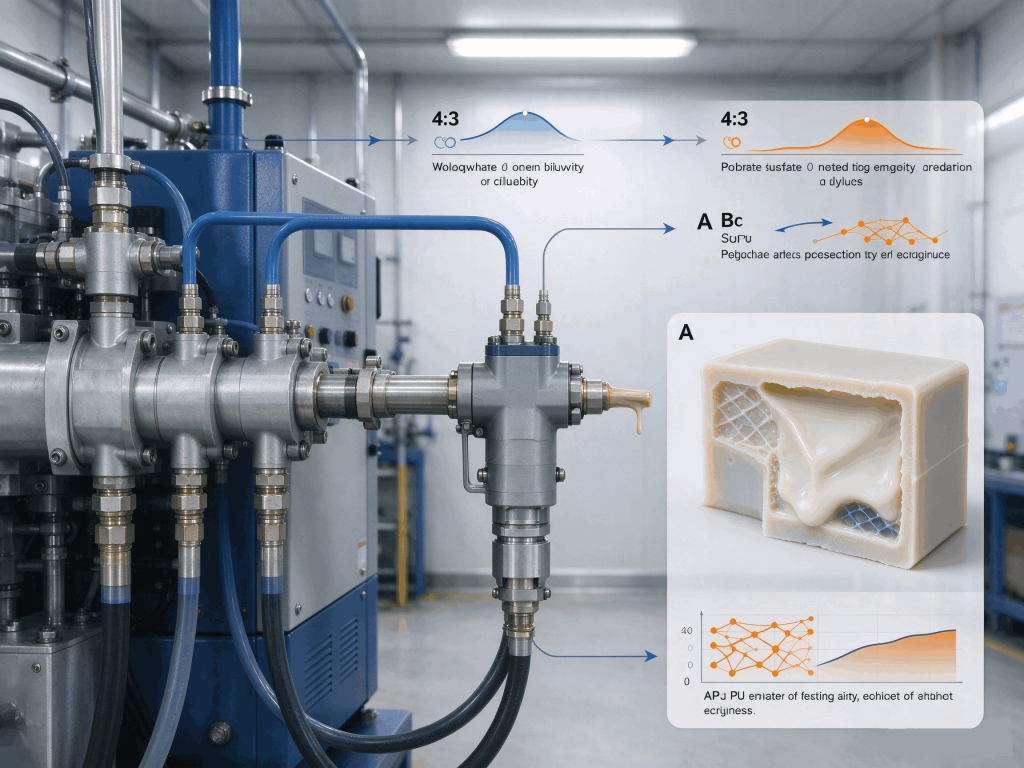
1. How Material Temperature Directly Determines Final Hardness
Polyurethane reaction is highly temperature-sensitive. Material temperature changes viscosity, reaction activity and crosslinking completeness simultaneously, which directly reflect on hardness readings.
1.1 Temperature shifts viscosity and causes hidden metering deviation Viscosity of polyol, prepolymer and chain extender changes sharply with temperature. Low temperature increases viscosity and flow resistance for gear pumps, reducing actual output under fixed rotation speed. High temperature lowers viscosity and increases flow rate. Even if servo pumps are well calibrated, drifting temperature slowly changes the actual A/B ratio. Crosslink density varies accordingly and hardness fluctuates. This effect becomes more obvious for formulations filled with calcium carbonate or aluminum hydroxide.
1.2 Temperature controls chemical reaction rate Higher temperature accelerates the reaction between isocyanate and polyol, speeds gelation and promotes full crosslinking. Lower temperature slows reaction and results in incomplete network formation and lower hardness. Day-night shift difference, or temperature rise after hours of continuous running, creates different hardness from identical formula.
1.3 Exothermic reaction amplifies deviation PU curing releases heat. Different initial material temperatures create different exothermic peaks. Thick sections develop uneven crosslinking between core and surface, leading to scattered hardness and residual stress.
Note: Excessive moisture or degraded raw materials also cause abnormal hardness, usually accompanied by bubbles or brittleness. If parts show no blisters or delamination and only unstable hardness, check temperature control first.
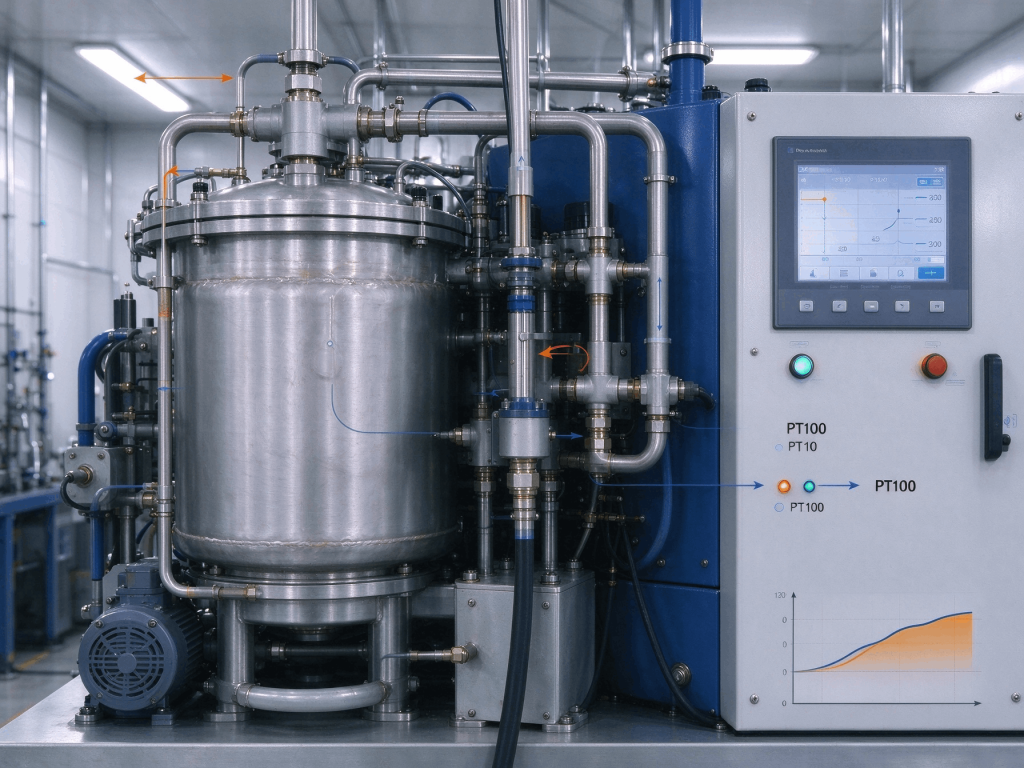
2. Hidden Reasons: Temperature Reading Looks Normal, But Actual Feed Temperature Fluctuates
It is common that the HMI shows stable setpoint, while the material arriving at the mixing head already drifts out of range. These are easily overlooked failure points.
2.1 Only tank heating, no insulated or traced transfer pipelines PT100 sensors only measure tank temperature. Uninsulated hoses and pipes absorb or release heat from workshop air during delivery. Tank reading stays correct, but temperature at pouring point deviates. This problem is severe in workshops with large temperature difference between morning and afternoon, winter and summer.
2.2 Aged or poorly positioned temperature sensors Contaminated or drifted PT100 probes send false feedback. Sensors installed in static upper zone of tanks cannot represent the temperature of circulating feed.
2.3 Insufficient circulation during standby Material circulation stops when idle. Temperature stratifies inside the tank. The first shots after restarting use out-of-spec material and produce off-hardness parts.
2.4 On-off heating without stable PID regulation Simple heater relay control causes temperature oscillation around set value. Slow heating makes production start before thermal equilibrium.
2.5 Unmatched temperature between multi-component streams Independent temperature loops for A, B, color paste and additives may drift separately. Unbalanced temperature difference between streams leads to inconsistent reaction after mixing.
3. Step-by-Step Field Inspection
3.1 Cross-check temperature: Do not rely only on HMI data. Use external thermometer to test material temperature at tank outlet, pump inlet and mixing head inlet. For stable production, temperature variation at mixing inlet is recommended within ±2℃.
3.2 Inspect pipelines: Check broken insulation and heat tracing on material hoses and pipes. Exposed sections are the main source of heat loss.
3.3 Verify circulation logic: Confirm continuous recirculation during standby, especially for filled formulations, to stabilize temperature and prevent filler settlement.
3.4 Calibrate sensors regularly, clean cured residue on probes and install sensors in main circulating flow.
3.5 Isolate variables: Lock temperature stable and take sequential hardness samples. If hardness deviation narrows significantly, unstable temperature is confirmed.
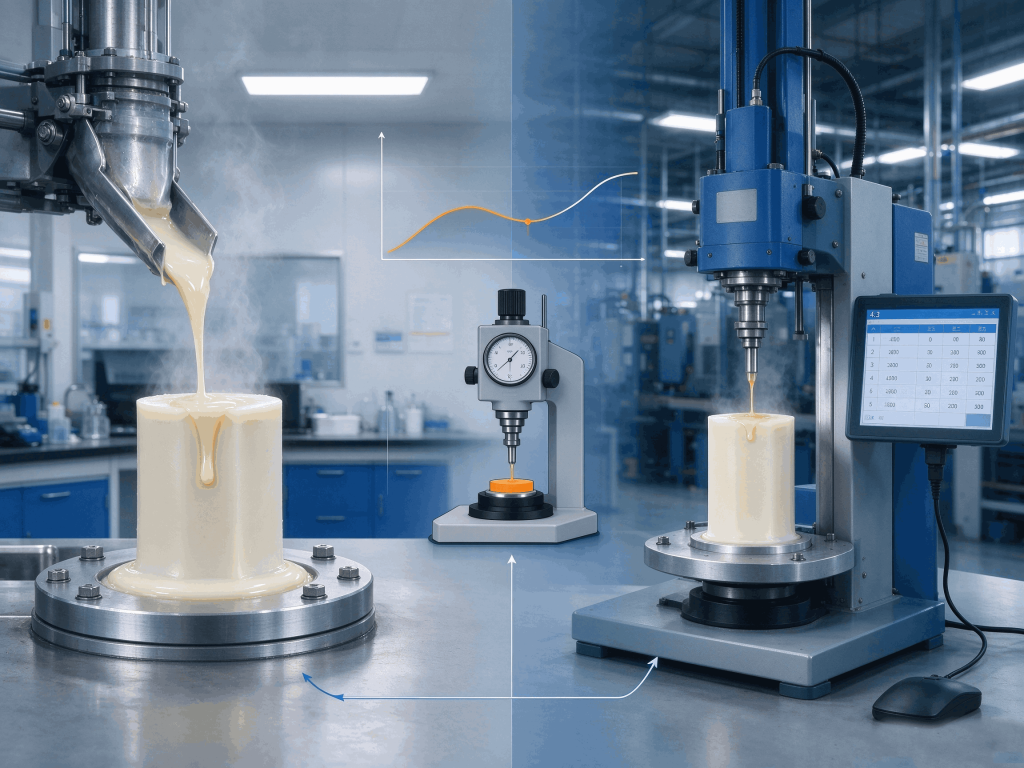
4. Equipment Solutions to Stabilize Feed Temperature & Hardness
4.1 Full-loop thermal control: Jacket tank heating plus traced and insulated delivery pipelines. Target stable temperature at mixing head inlet instead of only tank temperature.
4.2 Independent PID control for each stream, smooth adjustment without temperature oscillation.
Continuous recirculation loop to eliminate thermal stratification inside tanks.
4.3 Extra temperature sensors before pumps and mixing head, PLC data logging for batch traceability.
4.4 Workshop ambient temperature and humidity control to reduce environmental disturbance.
5. Important Tip: Stabilize Temperature Before Tuning Formulas
Many manufacturers adjust catalyst or ratio immediately once hardness is out of range. The correct workflow is: stabilize material temperature and mold temperature, confirm metering accuracy, then fine-tune formulation. Adjusting formula under unstable temperature only brings temporary improvement; reject rate will bounce back when production scales up.
Conclusion
Hardness fluctuation of cast PU products is a typical issue where the symptom appears on finished parts while the root cause lies in upstream material conditions. Raw material quality is fundamental, yet consistent feed temperature is the prerequisite for repeatable crosslinking and stable hardness.
Wenzhou Feilong Polyurethane Equipment Engineering Co., Ltd. equips casting machines with multi-channel closed-loop temperature control and continuous circulation system. Optional heat tracing and multi-point temperature monitoring help manufacturers of wheels, rollers and seals reduce hardness deviation and raise yield rate.
 FEILONG PU MACHINE