Search the whole station
Wenzhou Feilong Polyurethane Equipment Engineering Co., Ltd.
Chinese website: http://www.pumcn.com/
English website: https://www.flpumachine.com/
Polyurethane flexible foam carpet backing requires consistent thickness and stable resilience to deliver steady shock absorption and noise reduction. Many production lines face two typical defects: inconsistent thickness across the width, and poor resilience that cannot recover after compression.
Many manufacturers tend to adjust additives and formulas first, leading to high trial costs. In most cases, the root cause lies in unstable discharge of the pouring head and mismatched coordination between the pouring head and the whole coating line. Unstable metering, incomplete mixing and mismatched foaming timing will damage cell structure, resulting in thickness deviation and resilience loss. Below we introduce pouring head tuning and coating process optimization, plus supporting control tips.
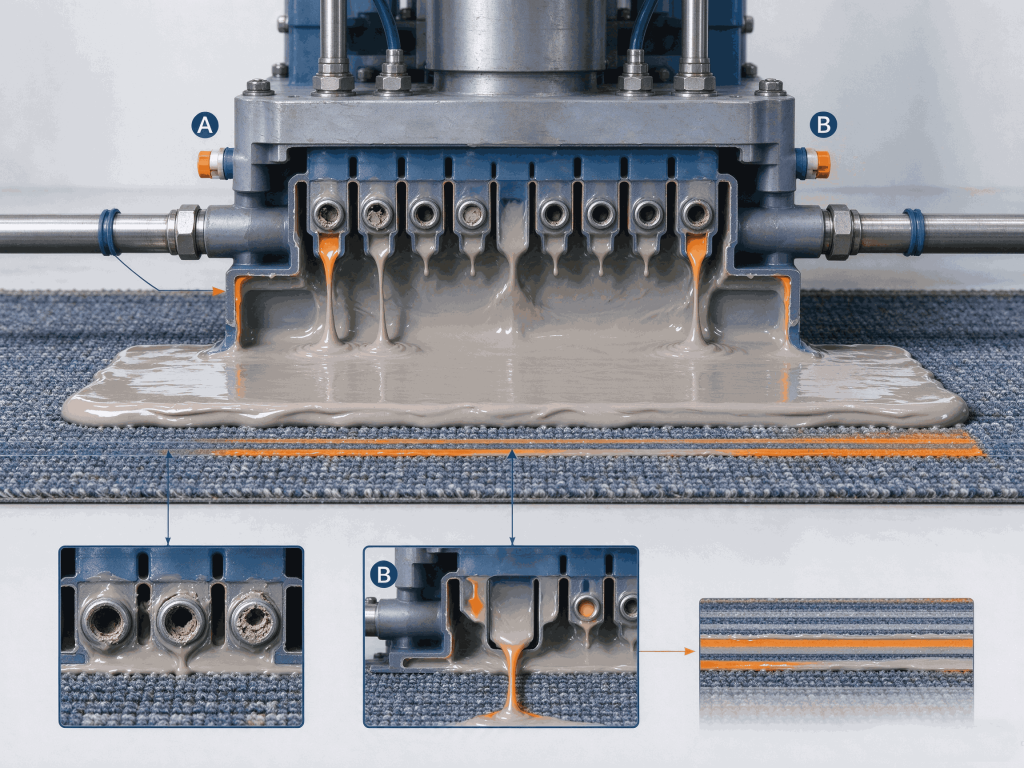
1. Pouring Head Adjustment for Uniform Thickness and Stable Resilience
The pouring head is the core of the carpet backing line. Uniform discharge and stable mixing directly determine cross-width thickness consistency and cell uniformity.
1.1 Flow rate and cross-width distribution adjustment
Most carpet backing adopts wide continuous coating. Uneven flow from outlets of the pouring head is the top cause of transverse thickness difference.
(1)Check flow at each outlet of the pouring head and calibrate flow balance. For reciprocating pouring heads, confirm steady travelling speed; acceleration or deceleration at start and stop positions will cause material accumulation and local thick spots.
(2)Clean cured residues inside the mixing head regularly. Local blockage reduces output at certain points and forms thin stripes. Worn seals cause cross-contamination of A and B components, shifting mixing ratio, creating irregular cells and closed-cell zones which reduce resilience.
(3)Mixing shear intensity: insufficient mixing leads to non-uniform cell size; excessive shear speeds up reaction, ruptures cell walls and causes foam collapse and poor rebound. Adjust mixing head speed moderately to obtain fine cells and proper open-cell ratio.
1.2 Stable pressure and recirculation control
Pressure fluctuation of metering pumps and unstable recirculation loop cause variable discharge. The foaming window for carpet backing is short; flow variation brings inconsistent density and thickness across the carpet, and uneven resilience.
(1)Maintain constant temperature of material tanks and continuous circulation of pipelines to avoid sedimentation and viscosity drift;
(2)Calibrate recirculation valves and pressure regulators regularly, to ensure smooth pressure transition between pouring and recirculation mode without pressure shock.
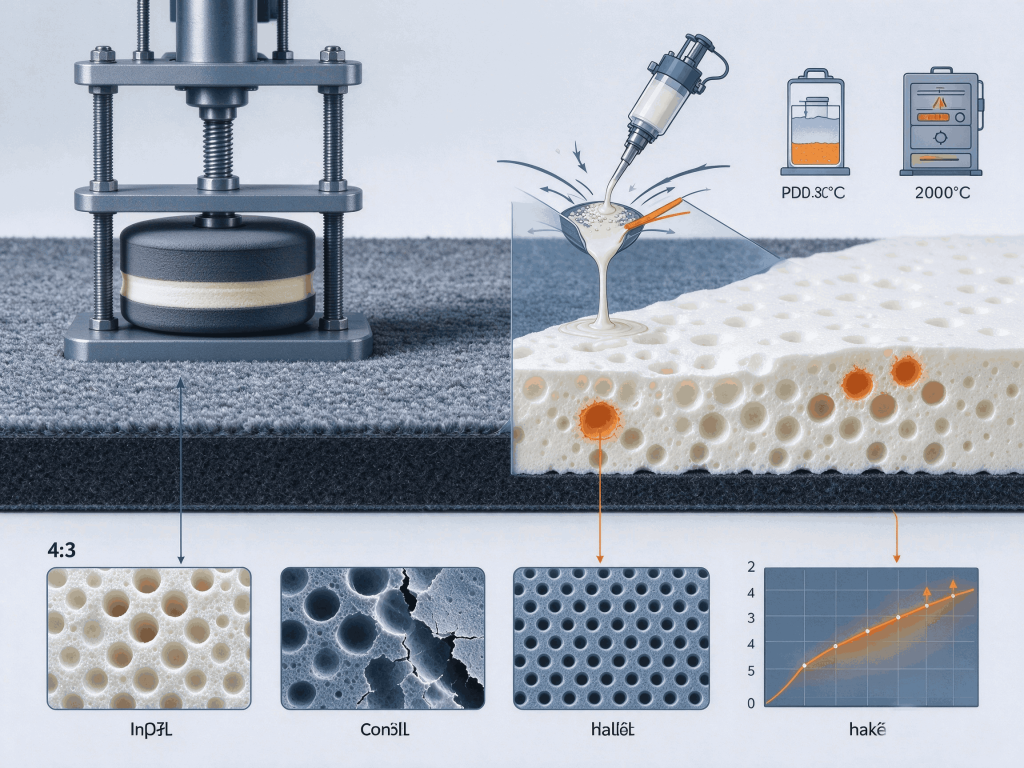
2. Coating Line Process Optimization
Even with stable pouring head output, matching of coating, doctor blade, conveying and foaming curing decides whether foam can spread evenly and rise normally.
2.1 Matching of line speed and output flow
Line speed and pouring output must be matched. If line speed rises while output stays unchanged, the backing becomes thinner; slow line speed accumulates material and creates thicker layers. Tuning rule: after formula and material temperature are fixed, lock total output first, then fine-tune carpet travelling speed to guarantee fixed material weight per unit area. Avoid frequent adjustment of line speed alone.
2.2 Doctor blade gap and flatness
The doctor blade controls initial wet-layer thickness. Deformed blades, uneven gap between two ends or blade vibration will produce thickness stripes.
(1)Keep the blade horizontal and rigid with identical gap on both ends; uniform gap between blade and roller to prevent over-scraping locally;
(2)Do not use too large blade angle. Sharp angle may damage fresh foam precursor, rupture cell structure and hurt resilience.
2.3 Temperature profile for foaming and curing
Heating curve after coating is critical. Rapid heating triggers fierce foaming, coarse cells and foam collapse; slow heating delays foaming and produces dense, stiff foam. PU carpet backing foam needs mild and uniform heating for gradual cell growth and stable open-cell structure, which is the foundation of good rebound. Zoned oven temperature control is recommended to avoid large temperature difference along the line.
2.4 Substrate tension control
Fluctuating tension of carpet greige goods causes wrinkling and wandering on rollers. Wet material laid on uneven base will form uneven thickness. Keep constant tension on unwinding, traction and winding units to maintain flat substrate.
3. Troubleshooting: Confirm whether defects come from pouring head or formula / post process
3.1 Alternating good and poor resilience along the carpet with thickness stripes: focus on pouring head discharge, mixing, pressure and nozzle blockage.
3.2 Poor resilience for the whole batch and permanent compression set: mostly related to mixing intensity, isocyanate index, silicone surfactant and water blowing system, together with pouring ratio accuracy.
3.3 Coarse cells and crumbly foam: insufficient mixing or out-of-control reaction speed, adjust mixing head speed and raw material temperature first.
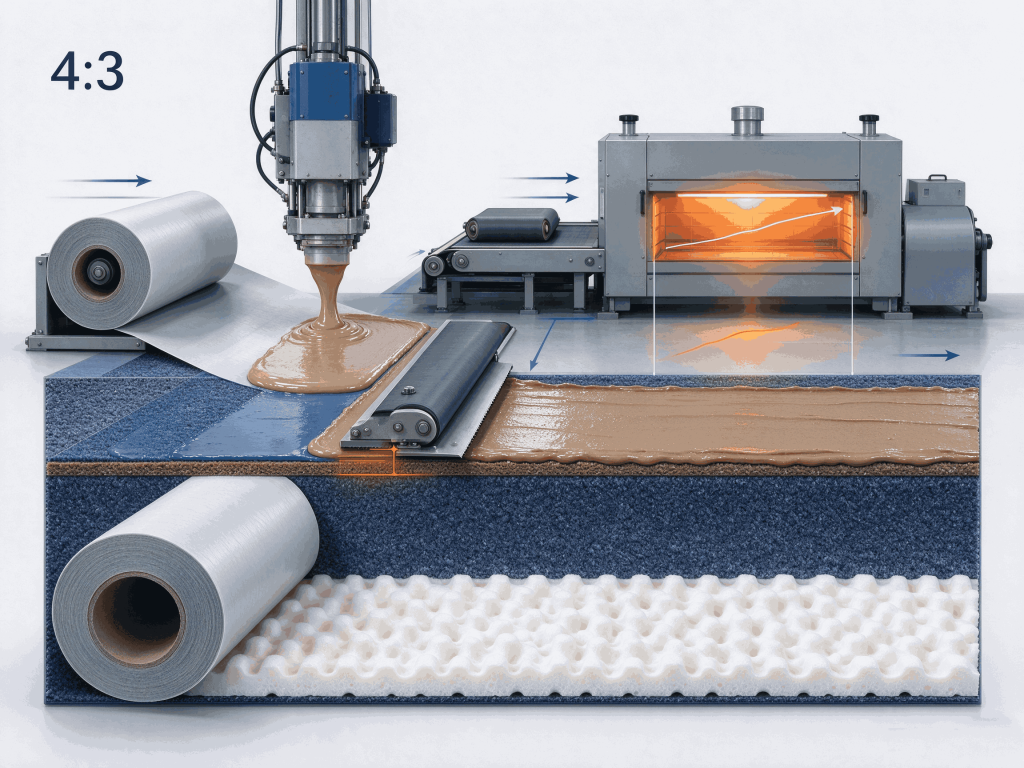
4. Recommended On-site Debugging Sequence
4.1 Clean pouring head and pipelines, inspect seals and pressure regulators, confirm stable A/B ratio;
4.2 Calibrate cross-width discharge of pouring head for uniform material distribution;
4.3 Fix material temperature and formula, lock output flow and match carpet travelling speed;
Level the doctor blade and adjust gap, set oven temperature zones;
4.4 Run small trial batches, test thickness tolerance, rebound rate and compression set. Change only one parameter each test.
5. Summary
Uneven carpet backing thickness is mainly caused by unbalanced cross-width discharge, flow pressure fluctuation, mismatched doctor blade and line speed. Poor resilience is often a result of bad mixing and uncontrolled foaming temperature that destroy cell structure, besides formula factors. Stabilize metering, mixing and distribution of the pouring head first, then coordinate line speed, scraping, temperature and tension of the whole coating line. Thickness tolerance, rebound performance and compression set of carpet backing can be greatly improved. Wenzhou Feilong PU carpet backing foaming lines feature steady pouring head flow, uniform wide-width material distribution and zoned temperature coating system, supporting stable mass production of high-quality carpet backing.
 FEILONG PU MACHINE