Search the whole station
Wenzhou Feilong Polyurethane Equipment Engineering Co., Ltd.
Chinese website: http://www.pumcn.com/
English website: https://www.flpumachine.com/
Polyurethane elastomer wheels are widely used on AGVs, forklifts and material handling equipment, requiring high compactness, interlayer bonding strength and stable adhesion between PU and metal hub. Three typical defects frequently occur in production: internal blisters, delamination and debonding between polyurethane and metal core.
Many factories simply adjust temperature or replace adhesive when defects appear, yet the problem keeps recurring. Defects usually come from three categories: equipment, raw materials and manufacturing process. Systematic inspection is required instead of random parameter adjustment.
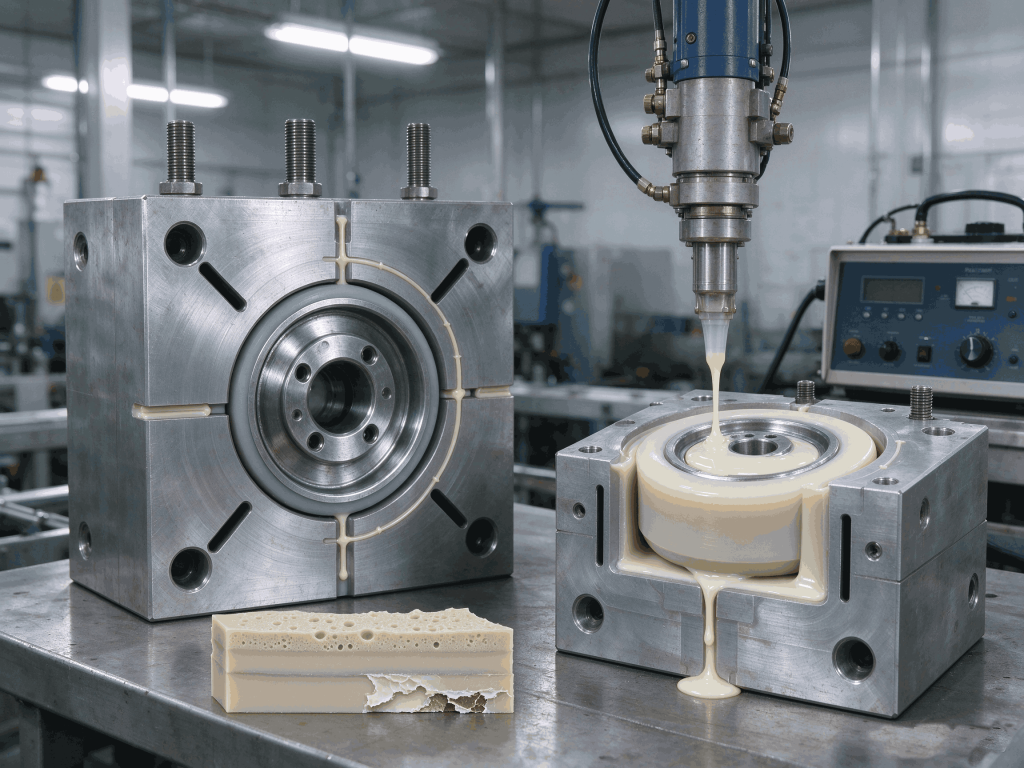
1. Equipment Inspection: Metering, Mixing, Temperature Control, Circulation and Degassing
Casting equipment is the foundation of stable production. Poor machine condition will lead to defective products even with good formula and operation.
1.1 Metering system: Ratio drift is a major trigger. Worn metering pumps, pressure fluctuation or failed closed-loop servo control will cause actual A/B component ratio to deviate from formula, resulting in uneven reaction, internal blisters and brittle layers. For filled formulations, check intermittent blockage which causes unstable instantaneous flow.
1.2 Mixing head performance: Worn blades, excessive clearance or insufficient rotation speed lead to incomplete mixing. Partial over-reaction or under-reaction creates tiny internal bubbles and delamination after curing. Residual old material from incomplete cleaning will also form inclusion layers.
1.3 Temperature control system: Poor heat exchange of tank jacket, drifted temperature sensors and failed insulation cause unstable raw material viscosity and unpredictable reaction speed. Overheating accelerates reaction and traps gas; low temperature slows curing and easily entraps air.
1.4 Circulation and vacuum degassing: No circulation during standby leads to filler settlement and moisture absorption. Insufficient vacuum cannot remove dissolved gas inside raw materials, which releases and forms blisters after casting.
1.5 Pipeline, valve and seal: Air leakage from seals and pipelines draws air into material stream. Abnormal switching valves introduce bubbles during pouring.
✅ Equipment improvement: Calibrate dosing accuracy regularly; inspect mixing head wear parts; verify temperature probes; maintain continuous circulation for filled slurry; service vacuum degassing unit periodically.
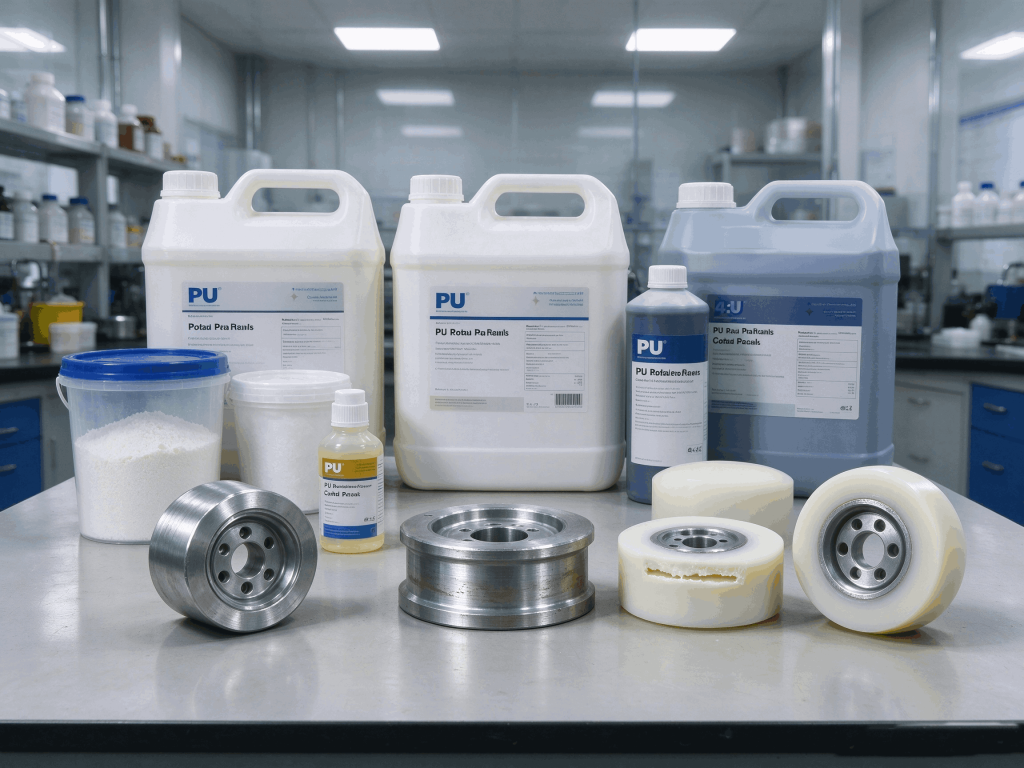
2. Raw Material Inspection: Moisture, Formula, Additives and Bonding System
Polyurethane is highly sensitive to moisture. Matching of bonding system directly determines whether debonding occurs.
2.1 Excessive moisture content: Moisture in polyol or curing agent reacts with isocyanate and generates carbon dioxide, the most common source of blisters. Damp storage, loose drum lids and water-containing fillers such as calcium carbonate and aluminum hydroxide will worsen the issue.
2.2 Unmatched formulation: Excessive catalyst accelerates reaction and locks bubbles inside. Random mixing of different polyol or isocyanate grades brings unstable molecular weight and large internal stress, which causes delamination after curing. Overfilled or poorly dispersed fillers form weak interfaces.
2.3 Mismatched primer or adhesive: Incompatible bonding agent, expired primer or contaminated coating fails to form chemical bonds between PU and metal hub, resulting in debonding under load.
2.4 Expired or poorly homogenized raw materials: Sedimented components without full stirring before use cause inconsistent performance.
✅ Raw material improvement: Store materials sealed and moisture-proof; test moisture content before use; fix raw material grades; use matching primer and adhesive system; pre-disperse fillers sufficiently.
3. Process Inspection: Hub Pretreatment, Pouring, Mold Temperature, Curing and Post-Cure
Most debonding and delamination defects originate from mold and pre-treatment procedures.
3.1 Poor hub surface preparation: Oil, rust and dust remaining on metal surface; insufficient blasting roughness or oxidized surface after blasting; uneven primer coating, missing coating or improper open time of primer are the top causes of debonding.
3.2 Mold and mold temperature: Low mold temperature reduces fluidity and traps air; uneven mold temperature leads to inconsistent curing speed and internal stress. Improper vent design blocks air discharge and forms blisters.
3.3 Casting operation: Too fast pouring or incorrect pouring point induces turbulent flow and air entrapment. Over-thick single pouring layer accumulates internal heat and gas expansion.
3.4 Curing, demolding and post-curing: Early demolding before full crosslinking results in low strength and easy delamination. The interface may be torn during demolding. Uncontrolled temperature and humidity during post-curing cause delayed debonding and separation.
3.5 Workshop humidity: High ambient humidity makes fresh material continuously absorb moisture, creating dense surface pinholes.
✅ Process improvement: Standardize degreasing, blasting and priming workflow; stabilize mold temperature and pouring speed; optimize mold vents; follow fixed curing and post-curing schedule; dehumidify workshop in humid seasons.
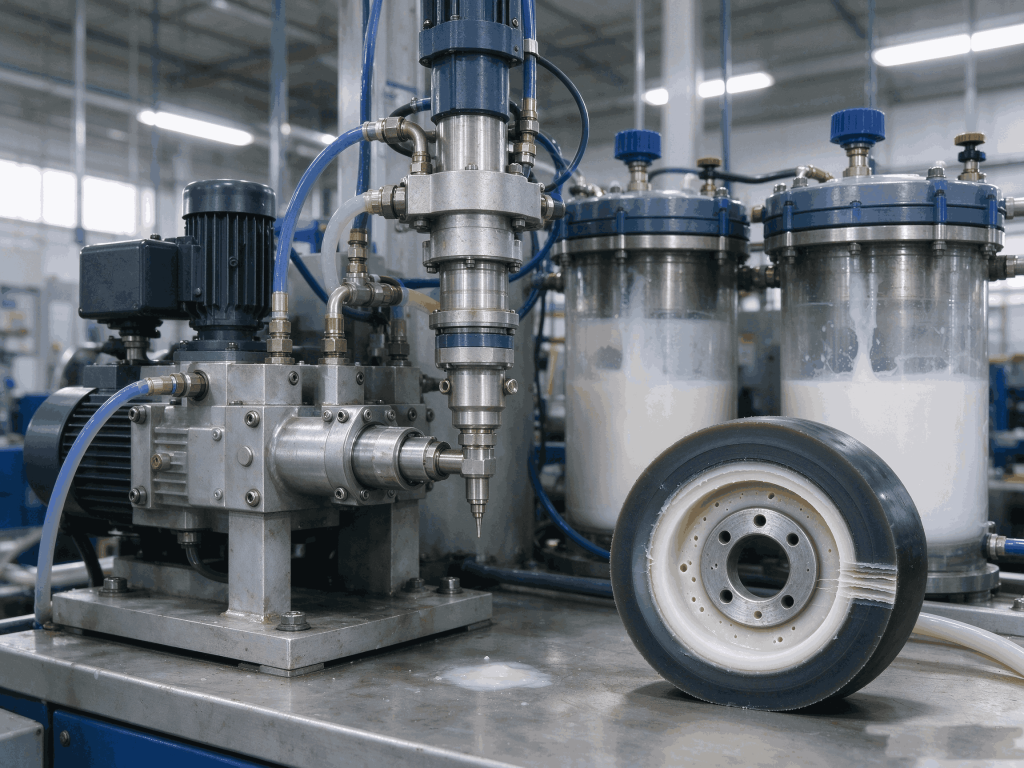
4. Quick Guide to Locate Defect Root
4.1 Internal blisters: Check raw material moisture, vacuum degassing and mixing ratio first;
4.2 Surface pinholes: Check workshop humidity, mold vents and air entrapment during pouring;
4.3 Internal delamination inside PU layer: Check incomplete mixing, ratio deviation and curing stress;
4.4 Debonding at metal-PU interface: Check hub surface treatment, primer and primer open time.
Conclusion
Blisters, delamination and debonding of PU wheels are rarely caused by a single factor; most failures come from combined problems of equipment, raw materials and process. It is recommended to build a defect tracking form to record ratio, temperature, batch number and hub treatment process for comparison and elimination.
Wenzhou Feilong Polyurethane Equipment Engineering Co., Ltd. supplies PU elastomer casting machines and complete wheel casting lines. We provide machine commissioning and process guidance to solve casting defects including blisters, delamination and debonding of polyurethane wheels.
 FEILONG PU MACHINE