Search the whole station
Wenzhou Feilong Polyurethane Equipment Engineering Co., Ltd.
Chinese website: http://www.pumcn.com/
English website: https://www.flpumachine.com/
In mining, sand, conveying and mineral processing industries, rollers, liners and wear plates endure continuous impact, friction and cutting from grit. Ordinary rubber, steel and cast stone suffer rapid wear and tearing. Castable polyurethane (CPU) delivers balanced performance in wear resistance, resilience, tear resistance, oil and hydrolysis resistance, making it widely used for mine wear parts, coated rollers and hopper liners. However, polyurethane is not universally invincible. Poor material selection or improper process will cause delamination, cracking, chipping and premature abrasion. Below are practical application points for rollers, liners and mining wear components.
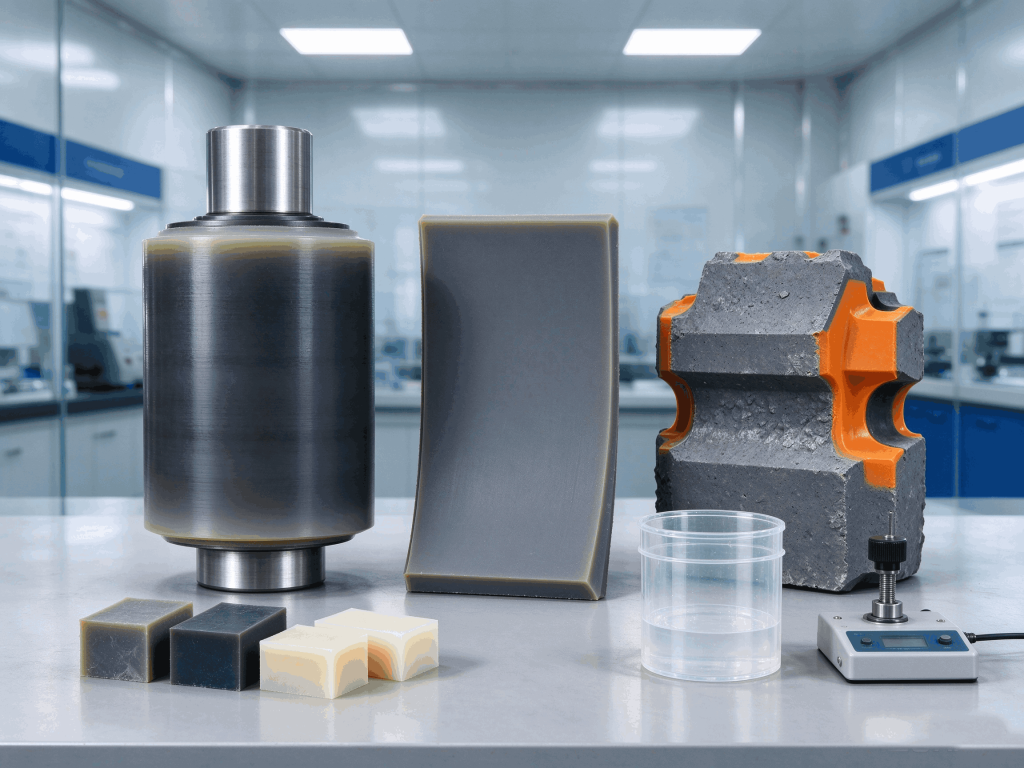
1.Select system and hardness according to working conditions, not blindly pursue high hardness
Cast PU includes polyester and polyether systems with a wide hardness range. Rollers usually adopt medium‑low hardness for compression resistance and rebound. Chute and hopper liners for sand cutting mostly use medium‑high hardness. Impact‑resistant mining parts need both wear resistance and toughness; overly hard grades tend to crack under impact while overly soft grades heat up and wear fast. Polyester PU offers better wear and tear resistance yet weaker hydrolysis resistance for dry or oily conditions. Polyether PU excels in hydrolysis and low‑temperature performance for wet underground and washing environments. Many failures come from using one formula and one hardness for all products.
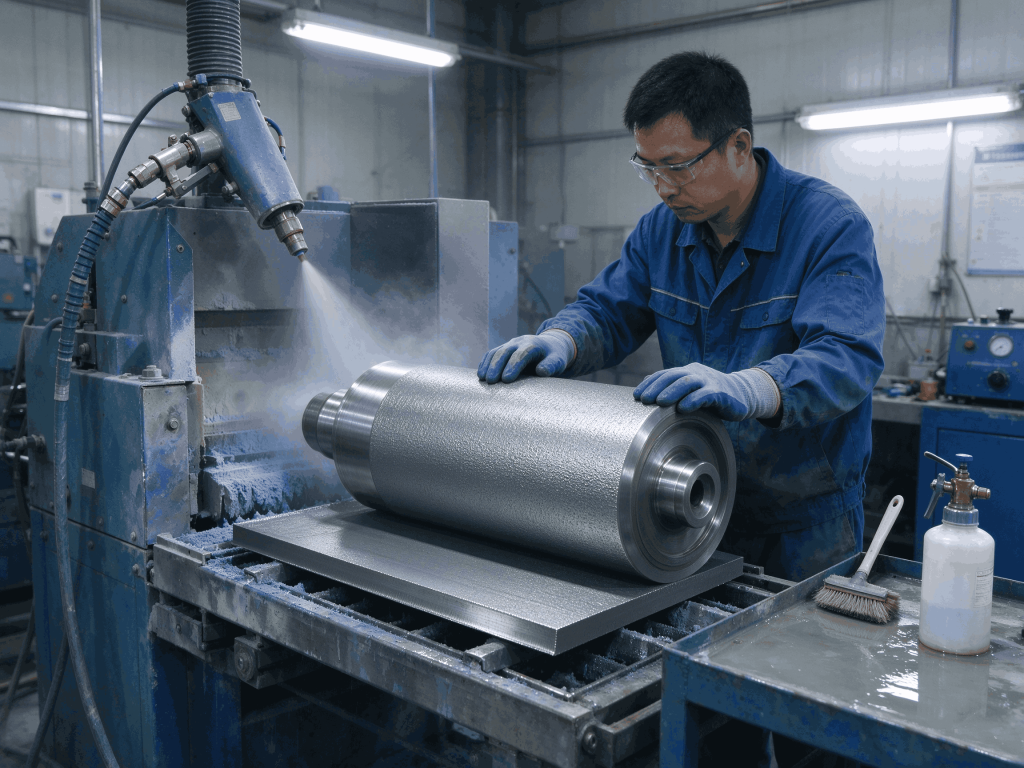
2.Substrate preparation determines bonding quality
Metal‑cored rollers and composite liners frequently fail by peeling. Standard treatment includes sandblasting for roughness, degreasing, drying, applying dedicated primer and casting within valid time. Oil, rust, moisture or expired primer creates an isolation layer between metal and PU, leading to separation under load and heat. For solid cast wear parts without metal substrates, keep moulds clean and apply release agent evenly and thinly to avoid insufficient filling, pores and pinholes.
3.Accurate ratio, degassing and casting path control guarantee internal quality
Cast polyurethane is highly sensitive to the mixing ratio of component A and B. Ratio drift changes hardness, tear strength and heat resistance. Thick mining parts and heavy coated rollers easily trap air without vacuum degassing. Hidden pores initiate cracks and chipping under load. Thick sections should avoid one‑shot large pouring to prevent exothermic runaway and heavy internal stress. Stable metering casting machines with static mixing and vacuum degassing are essential for consistent mass production.
4.Controlled temperature and staged curing reduce stress cracking
Curing does not finish once parts are demoulded. Thick mining components trap heat inside. Rapid heating or sudden cooling builds massive internal stress, which triggers spontaneous cracking under impact and temperature cycles. Recommended workflow: casting at controlled mould temperature, curing inside the mould, post‑curing in an oven in stages, then slow natural cooling. Roller coatings require careful oven temperature control. Excessive heat ages and embrittles PU; insufficient curing reduces wear and solvent resistance.
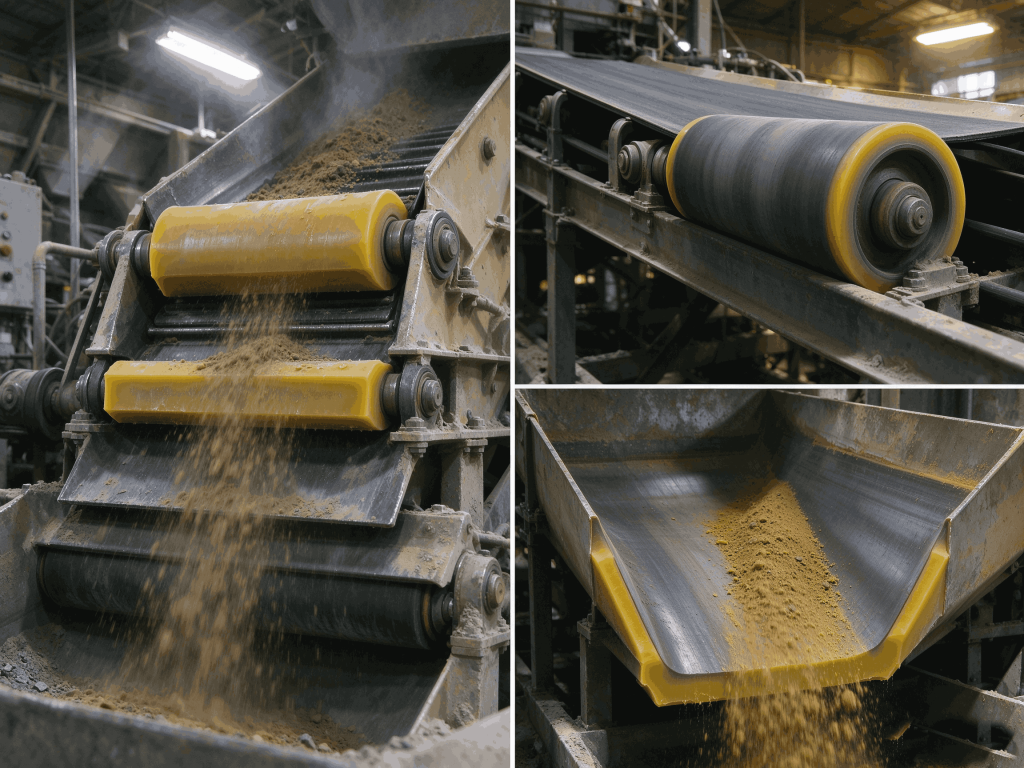
5.Match structural design with wear mechanism
Wear can be cutting, friction or fatigue from repeated impact. Chute liners and crusher guards mainly resist cutting by rock and sand, requiring high‑wear grades and smooth rounded transitions to avoid stress concentration. Conveyor rollers need good rebound and heat dissipation for continuous rolling friction. Vibrating screen components demand superior tear and fatigue resistance, especially at sharp corners. Exhaust and flow channels can be designed into thick castings to eliminate dead zones and trapped air.
6.Respect application limits: high temperature, strong chemicals and extreme impact Cast PU has clear operating boundaries. Continuous service above 100 ℃ accelerates softening and ageing. Strong acid or alkali immersion causes swelling and degradation. Severe impact from large sharp rocks may cause chipping even for premium wear grades. Confirm medium, temperature and maximum lump size before material selection, and add buffer structures if necessary.
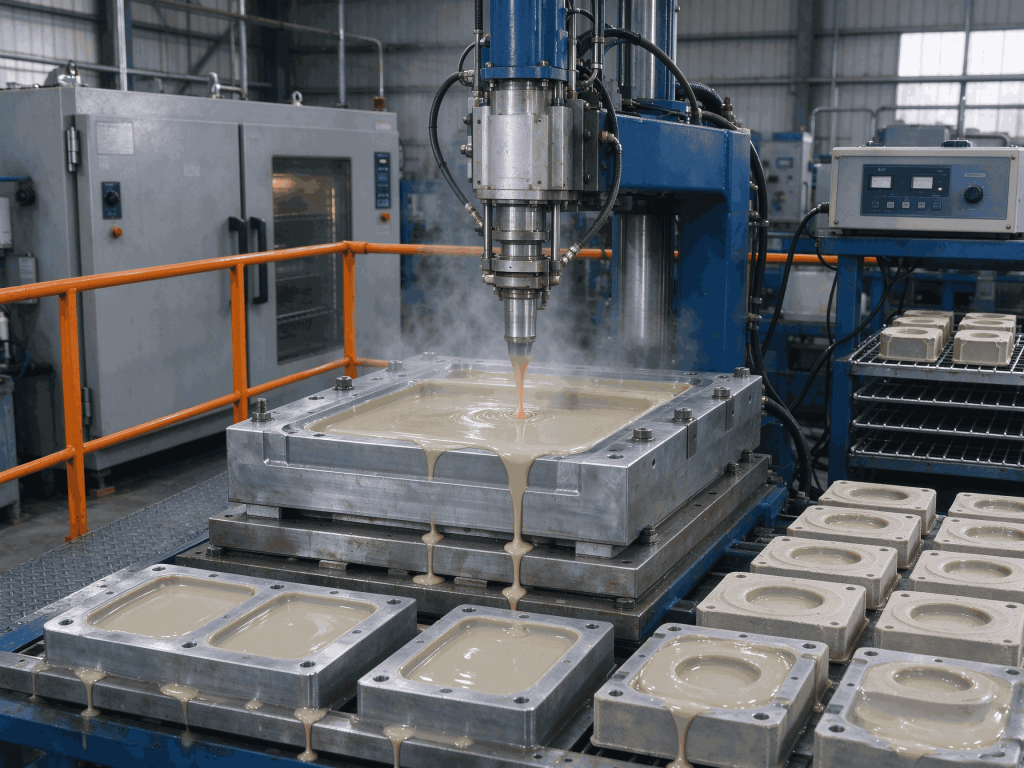
7.Equipment matching for stable mass production
Manual mixing works for small samples but brings inconsistent ratio and poor degassing for large orders. Dedicated casting machines precisely control flow, ratio, material temperature and pouring sequence for multi‑station continuous production. For filled wear‑resistant formulas, equipment must handle filler sedimentation and uneven discharge to ensure uniform wear performance across finished parts.
To sum up, the advantages of castable polyurethane rely on proper material selection, reliable bonding treatment and matched casting and curing processes. Rollers focus on adhesion, rebound and heat resistance; liners resist cutting and abrasion; mining impact parts balance wear, toughness and fatigue resistance. We provide custom pre‑polyurethane formulas and matching casting equipment, and welcome customers for on‑site material testing to verify bonding, wear and forming performance.
 FEILONG PU MACHINE