Search the whole station
Wenzhou Feilong Polyurethane Equipment Engineering Co., Ltd.
Chinese website: http://www.pumcn.com/
English website: https://www.flpumachine.com/
Polyurethane shock pads and buffers are widely used in construction machinery, vehicles, air compressors and automation equipment. They constantly bear cyclic compression, repeated impact and vibration. A common failure is that parts meet static hardness requirements but sag, bulge, crack or delaminate after long running time. Most fatigue failures come from improper casting process rather than raw material defects. Below are practical process optimization points.
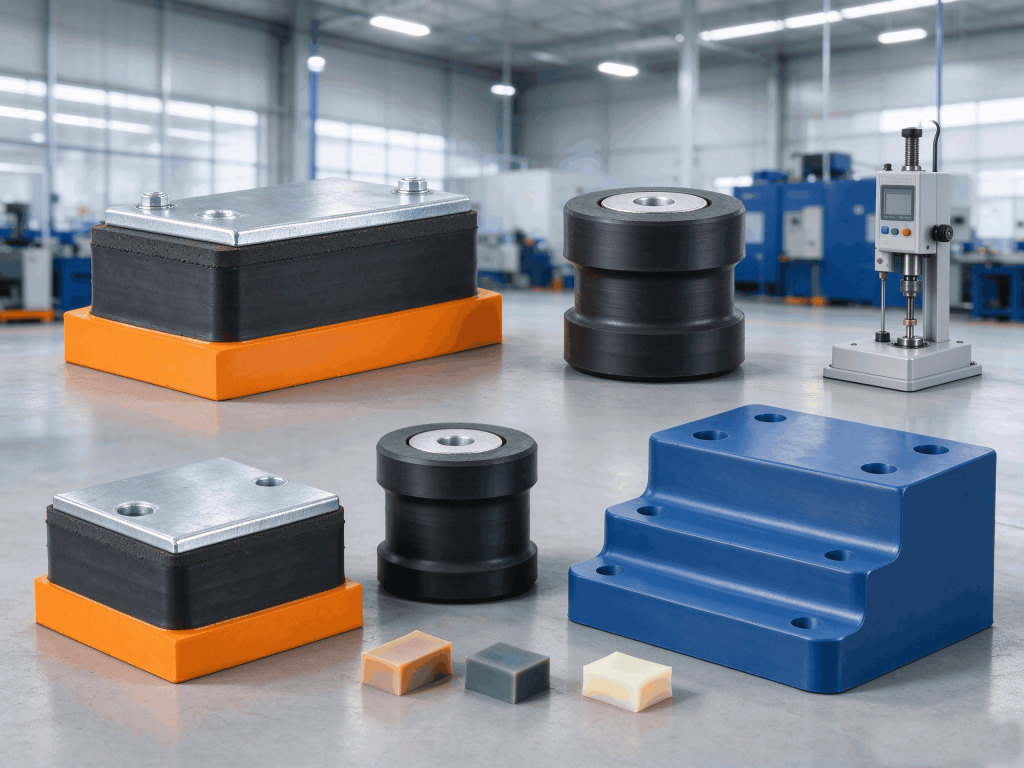
1.Select fatigue-oriented formula instead of focusing only on hardness
Shock-absorbing parts prioritize resilience, low compression set and low heat build-up under dynamic load. Polyester PU delivers high tear strength for medium impact at ambient temperature. Polyether PU features better hydrolysis resistance and lower heat generation, suitable for damp environments and high-frequency vibration. Excessive inorganic filler reduces cost and raises hardness but makes the material brittle; microcracks easily propagate under alternating load. For buffers, filler type and dosage must be strictly controlled, and matched pre-polymers ensure flexible molecular chains for repeated rebound.
2.Reliable substrate bonding prevents fatigue delamination
Many shock pads are bonded with steel plates or sleeves. Vibration creates continuous shear stress on the bonding interface. Even tiny bonding defects expand gradually under cyclic loading. Standard workflow: sandblasting for roughness, degreasing, thorough drying, applying dedicated primer and casting within valid time. Oil, moisture, rust or expired primer creates a weak boundary layer. For solid pads without metal inserts, keep moulds clean and apply thin, uniform release agent to avoid weak surface layers.
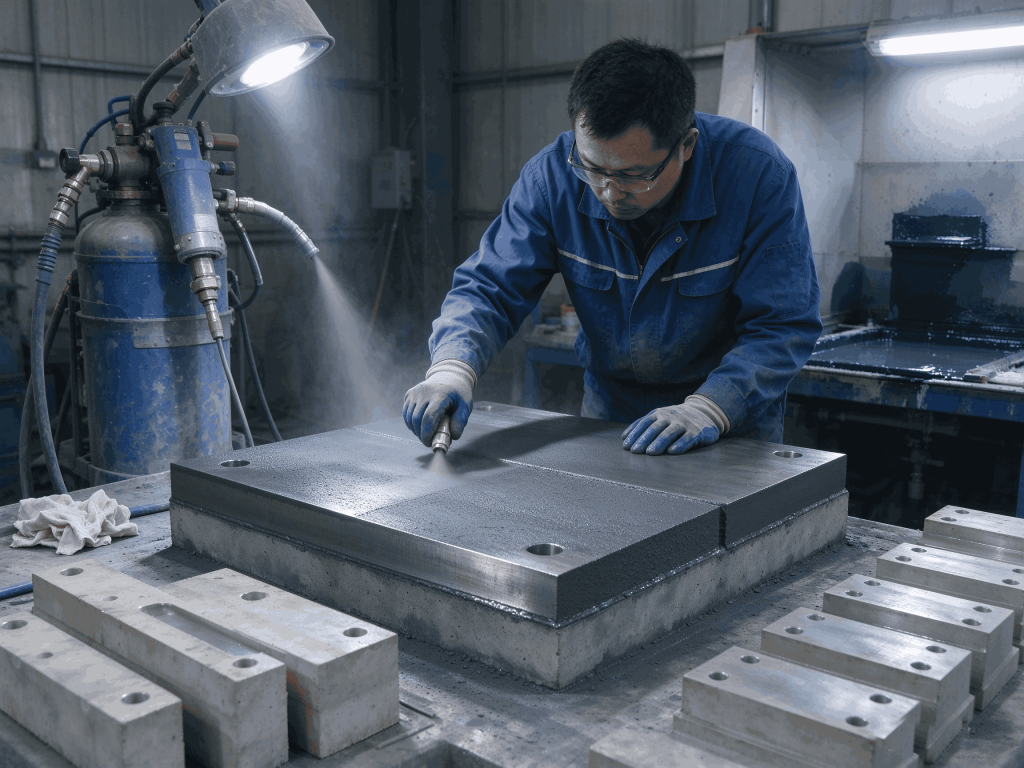
3.Vacuum degassing eliminates natural stress raisers
Voids, pinholes and internal cavities are major sources of fatigue failure. They may not show up in static tests, but concentrated stress around pores propagates cracks under repeated compression and vibration. High-viscosity shock-absorbing formulas easily trap air during mixing. Use casting machines with vacuum degassing for tank pre-degassing and mixing chamber defoaming. For thick sections, avoid fast one-shot pouring; feed slowly along mould walls to allow air to escape. Fewer internal defects greatly extend fatigue life.
4.Stable material and mould temperature reduce residual stress
Uneven curing caused by temperature fluctuation leaves residual stress inside castings. Combined with external cyclic load and temperature change, residual stress accelerates cracking. Control pre-polymer and chain extender temperature separately to stabilize viscosity and reaction speed. Preheat moulds to constant temperature instead of pouring into cold moulds. For thick buffers, manage exothermic reaction to prevent overheating and uneven cross-linking.
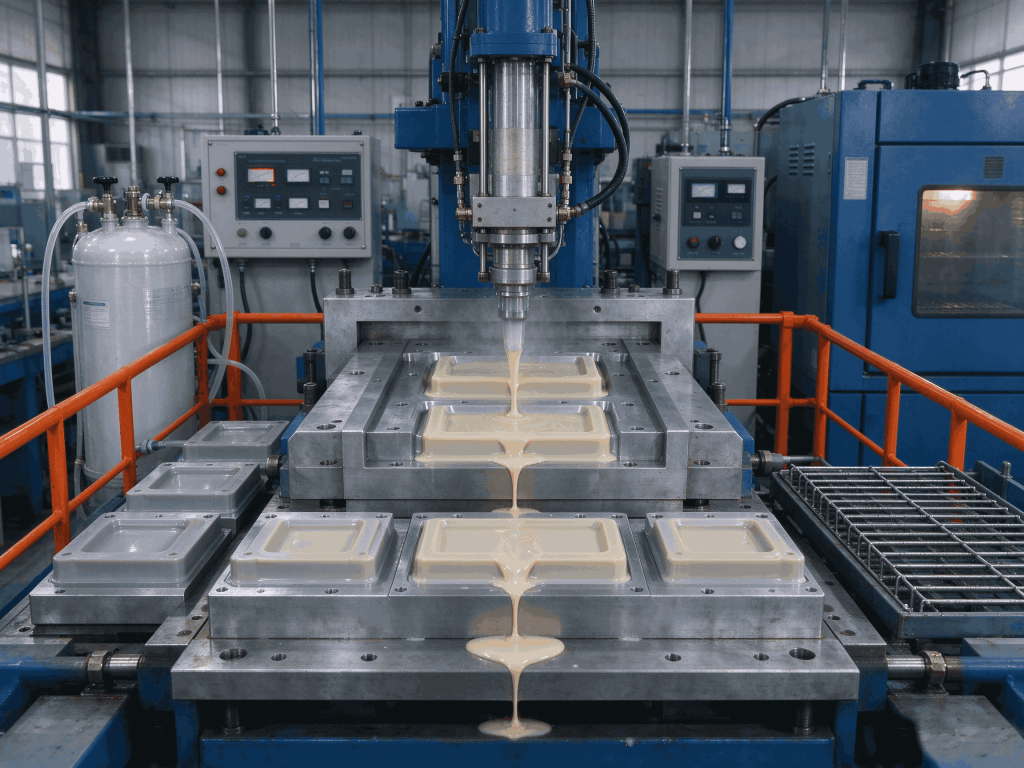
5.Staged post-curing lowers compression set
Demoulding does not complete cross-linking. Insufficient curing leads to irreversible deformation under repeated compression; pads gradually lose rebound and collapse. Recommended process: in-mould curing before demoulding, staged oven post-curing, then slow natural cooling instead of quenching. Fully cured PU achieves uniform cross-linking, low compression set and stable rebound after long cyclic loading.
6.Optimize gate and vent design to avoid stress concentration
Corners, steps and grooves are high-risk zones for fatigue cracks. Set gates on thick sections for smooth filling, and arrange vents at sharp transitions to eliminate short shots and weld lines. Weld lines are mechanically weak and prone to crack under alternating load. Keep casting flow steady and avoid turbulent feeding that causes invisible lamination and knit lines.
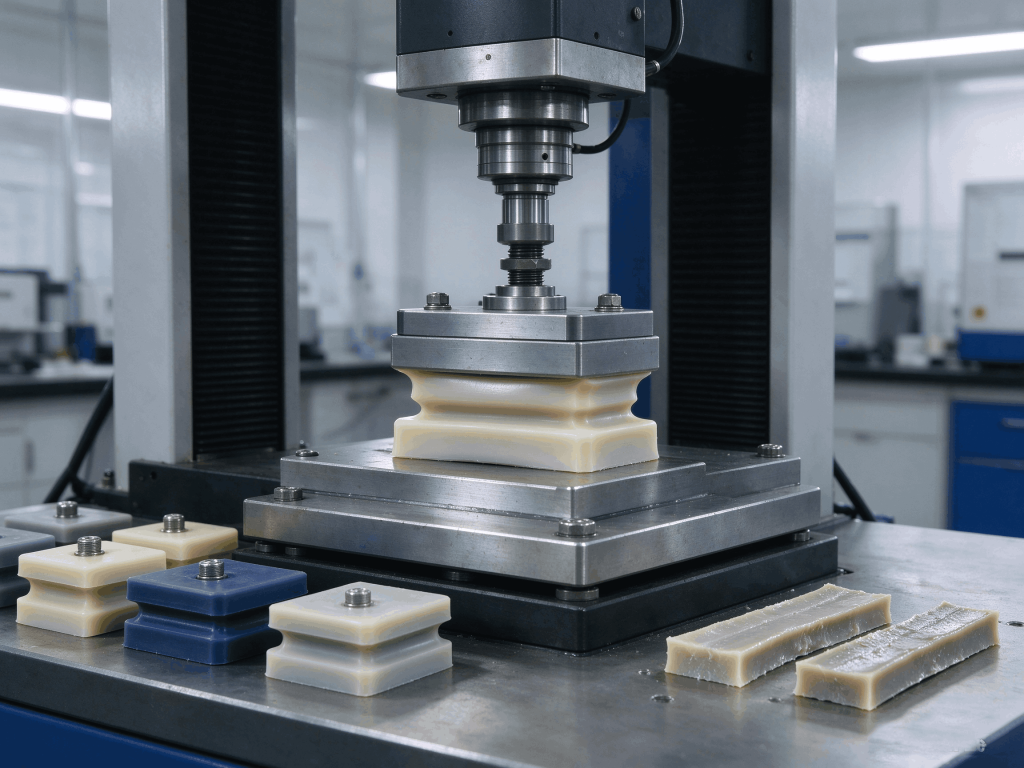
7.Precise ratio and consistent mixing guarantee stable dynamic performance
Minor ratio drift may barely change static hardness, but greatly reduce resilience, heat resistance and fatigue life. Calibrate metering pumps, pipelines and mixing units regularly to prevent leakage, sedimentation and uneven discharge. Clean static mixers frequently to avoid blockage and poor mixing. Inconsistent cross-linking creates weak spots that fail quickly under vibration.
8.Stress relief and dynamic testing for risk screening
Allow finished pads to rest at room temperature for stress release, especially thick castings. Where possible, run cyclic compression tests to simulate real working conditions and detect sagging, cracking and rebound decay. Many fatigue defects only appear under dynamic cycling and cannot be identified by static inspection.
In summary, improving fatigue performance of PU shock pads and buffers means removing stress concentration sources: voids, poor bonding, residual stress, weld lines and uneven cross-linking. Formulas determine intrinsic dynamic toughness, while casting, degassing, temperature control, curing and mould design decide final service life. We provide customized casting machines and process support for shock-absorbing parts, and welcome customers for on-site material testing of compression, rebound and fatigue performance.
 FEILONG PU MACHINE