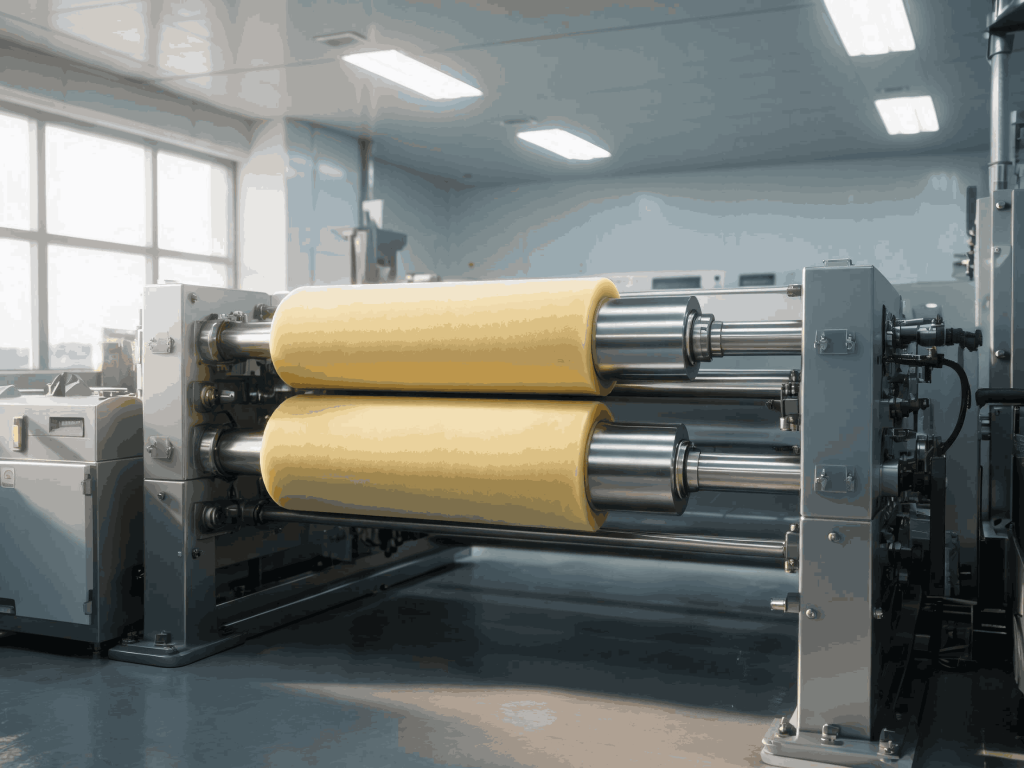
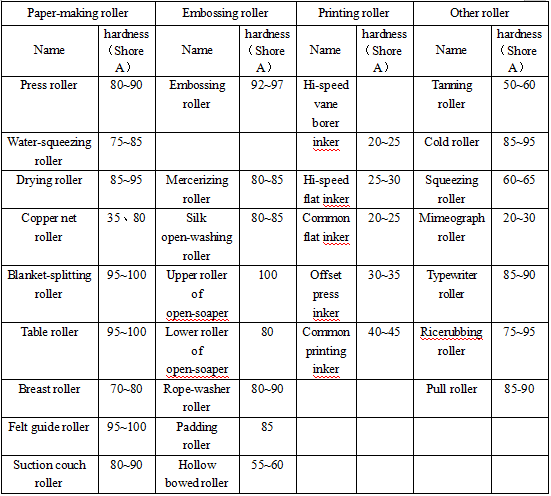
Ⅰ. General description: 1.Features and type of PU glue-roller: Cast-type PU glue-roller is one of rollers made of liquid PU rubber through pouring process, which has many advantages comparing to common rubber roller, such as: high mechanical strength (about 2-3 times that of gum rubber), high abrasion resistance (about 5-10 times that of gum rubber), high resistance to compression, large range of hardness, and high elasticity under high hardness condition—other rubber rarely has this feature, high surface finish, good machining property, and higher binding property with metal comparing to common rubber. It is suitable for using under condition of high pressure and reasonable linear velocity. At present, rapid development has made in PU glue-roller which replaces the common rubber widely used in the past. Pouring-type PU glue-roller mainly divided into three types: polyester, polyether and ploycaprolactone (main material for flexible chain). Generally speaking, polyester is mainly used for high- or mid-hardness glue-roller as it has good physical mechanical property and high resistance to solvent, so widely used for color roller in steel industry. Polyether is mainly used for high revolving speed and high hardness glue-roller as it has high resistance against water and low temperature, as well as comparative simple production process, so widely used for pull roller and embossing roller. While polyurethane is widely used for press roller and other roller with high requirement for property as it has good comprehensive property as well as high resistance against water and low temperature. 2.Basic requirements for PU material: (1)Meet the physical mechanical property required by glue-roller; (2)Good cohesiveness with roller core to meet the requirement of adherence forming; (3)The hardness of glue-roller should be even and meet requirements; (4)No air bubble, foreign matter or mechanical damage. 3. Main technical parameters of glue-roller: (1) Hardness: referential data for every kind of glue-roller
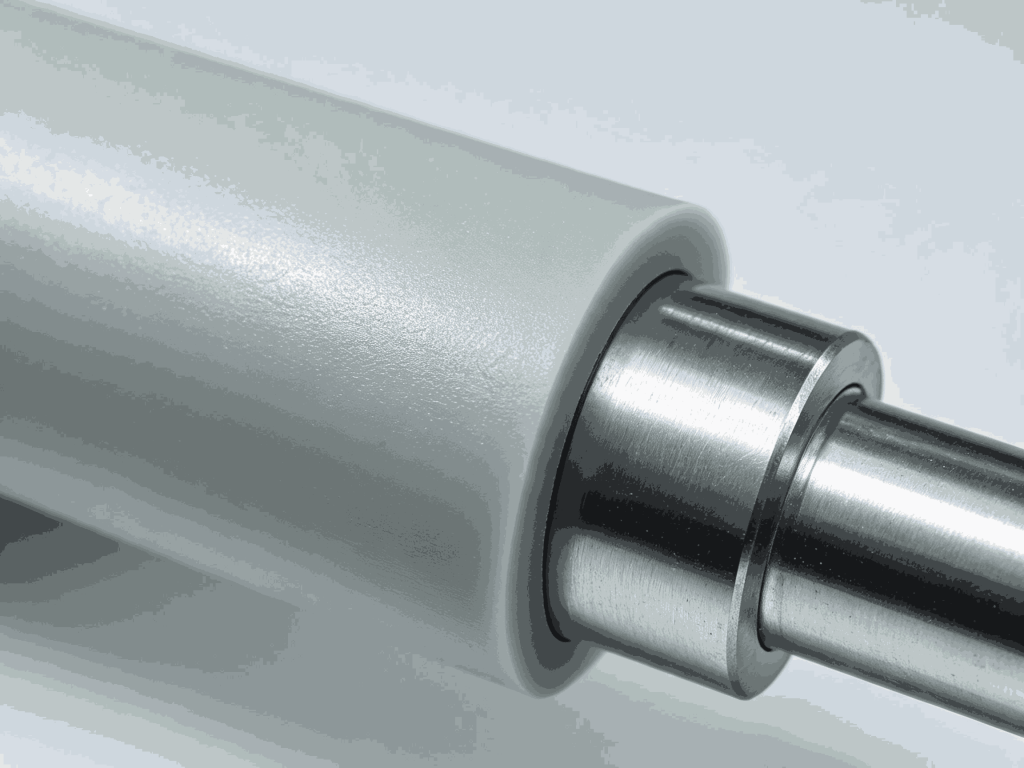
(2) Requirements for surface of glue-roller: high surface finish or other special process is needed for some roller according to specific purpose. (3) Core-end ratio: the difference between the diameter of core of roller and diameter of end of roller. Its purpose is compensating for deflection deformation of spindly roller during running. This value is proportion to the length of roller. 4. Pretreatment of metal roller core: (1)Carefully clean the surface of roller to wipe off oil, grease, metal or organic matter. The cleaning liquid should be common cleaning solvent or trichlorethylene. (2)Carefully clean the surface rust or oxide. Usually treated with sandblasting process. For carbon steel core, it is recommended to use aluminum oxide abrasive of 80-100 mesh; while for aluminum core, to treated with wet abrasive blasting of 140-320 mesh abrasive, and after blasting, clean away the dust remained on the surface with solvent. To improve the cohesiveness, carbon steel core should be bound within 4 hours after sandblasting and aluminum core should be bound within 72 hours after sandblasting. (3)Carefully coat appropriate binding agent such as NA-1, chemlock-218, Thixon422, etc. after coating, the roller core should keep in dry air 20 minutes, then treated for one hour under 90±10℃, then process with CPU pouring.
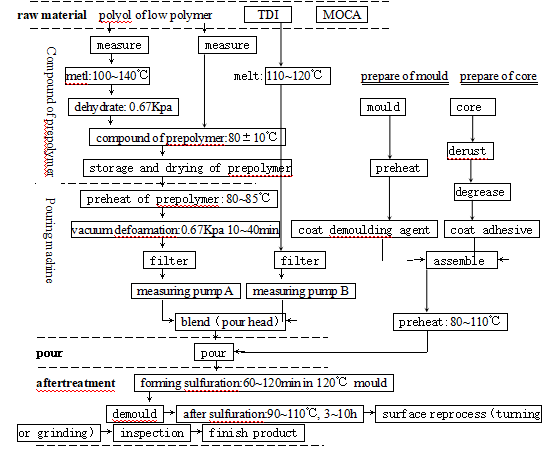
Ⅱ. Production process and technique for glue-roller: 1. Preparation of glue material and flow chart of pouring process (Take TDI-MOCA as an example)
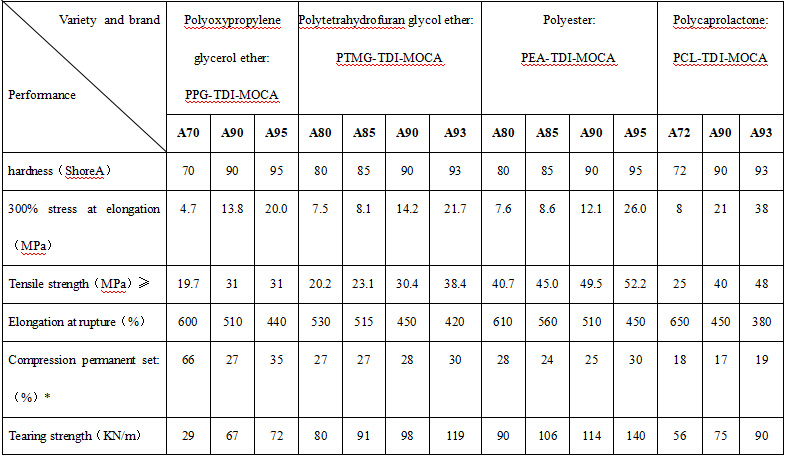
2. Main performance of pouring-type PU elastomer for glue-roller:
* Test condition:70℃×22h, compression ratio: 25%. 3. Production process: (1) Example of preparation for prepolymer:
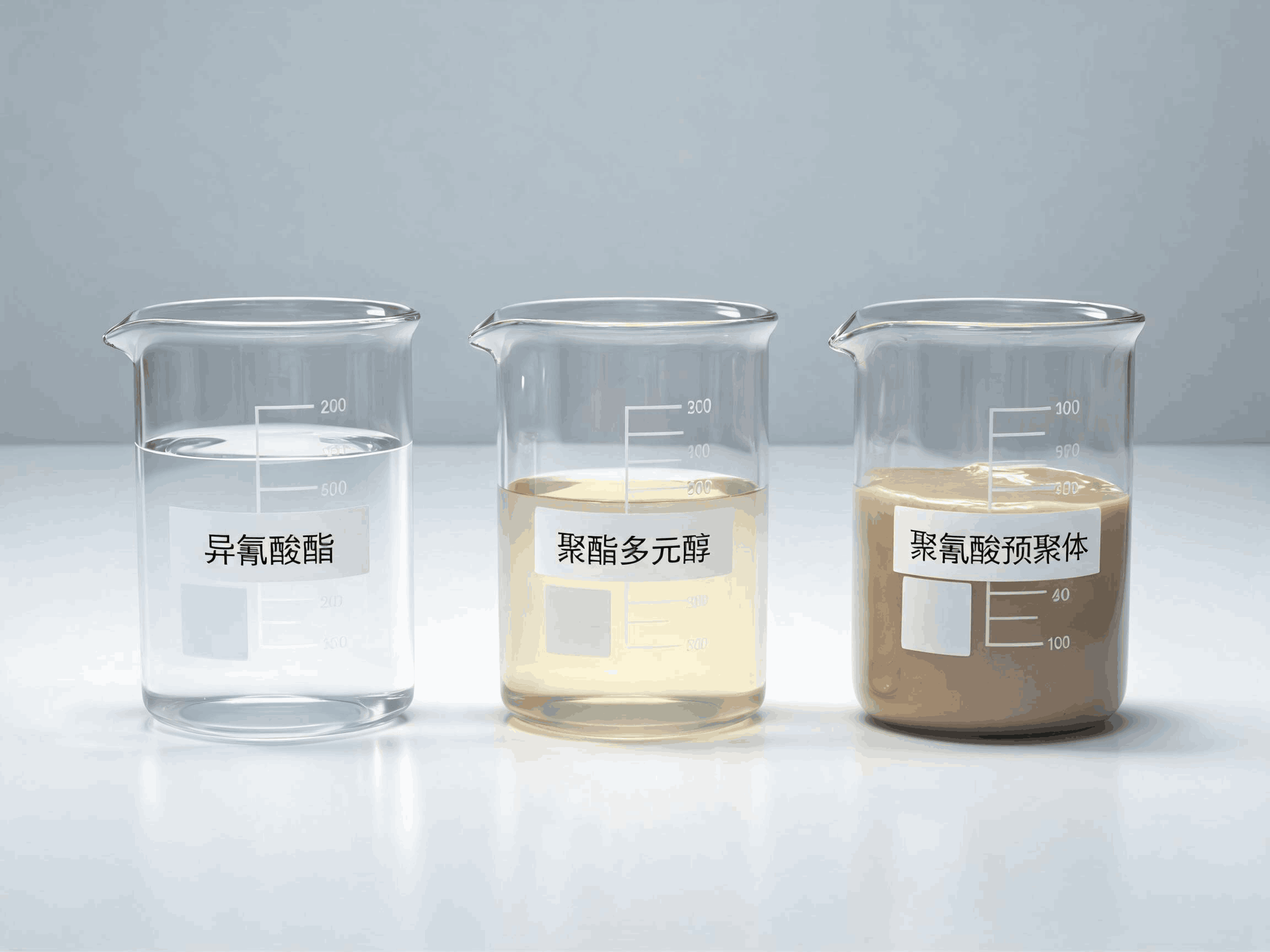
① Dehydration of polyester polyol in dehydrating pot: by polyester of Mn.2000 (hydroxyl value: 53-59, mgKOH/g melting point: 40~50℃). After heating and melting, put into a stainless steel or porcelain enamel pot with blender, the dehydrating temperature should be 100~140℃(100~110℃for polyether), process with vacuum dehydrating under pressure of 5mmHg for 30-60 minutes to make it moisture content less than 0.05% (the dehydration can be inspected by sight glass). For completely dehydrating, the blender should start intermittently. After dehydrating for a while, stop the heating of reaction pot to drop the temperature of material to 70-80℃. ② Compound of prepolymer in reaction pot: the performance of product is decided by raw material and mixing ratio of raw material as well as production process. Firstly, select appropriate raw material according to requirements such temperature, mechanical property, contact medium and life in the pot; then select appropriate mixing ratio and process conditions (mixing temperature, pouring time, demoulding time and sulfuration condition) according to required hardness. The dehydration of polyester and compound of prepolymer can be processed in the same pot for guarantee the quality of prepolymer, the compound of prepolymer should be processed under dry nitrogen condition. A cooling device is indispensable to prevent intense reaction or over temperature rising. In case of intense reaction, raw material should be added by several times to make process smoothly and easy control of temperature. The monomer content in compounded prepolymer is low and with right structure. React about 1-2 hours under 80±5℃, then analyze the content of isocyanate. Customer also can buy prepolymer directly from domestic or oversea supplier. ③Degas of prepolymer in reaction pot for compound of prepolymer or material tank A of pouring machine: defoam 30-60 minutes under temperature of 85±5℃and pressure of 5mmHg. (2) Pouring process:
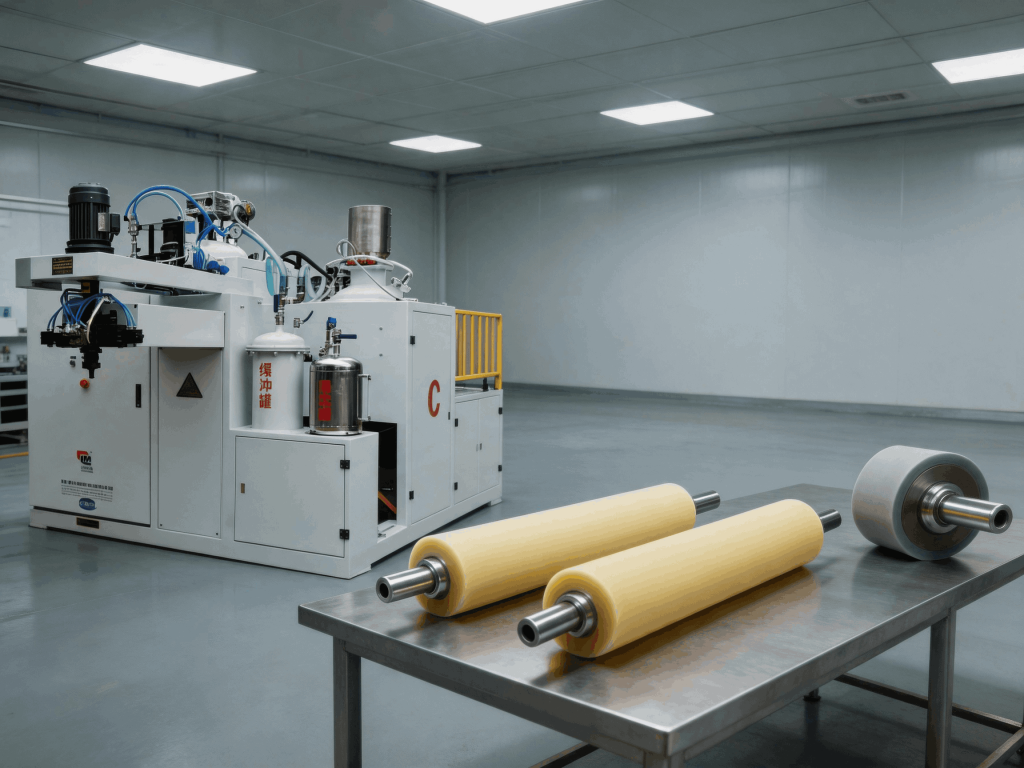
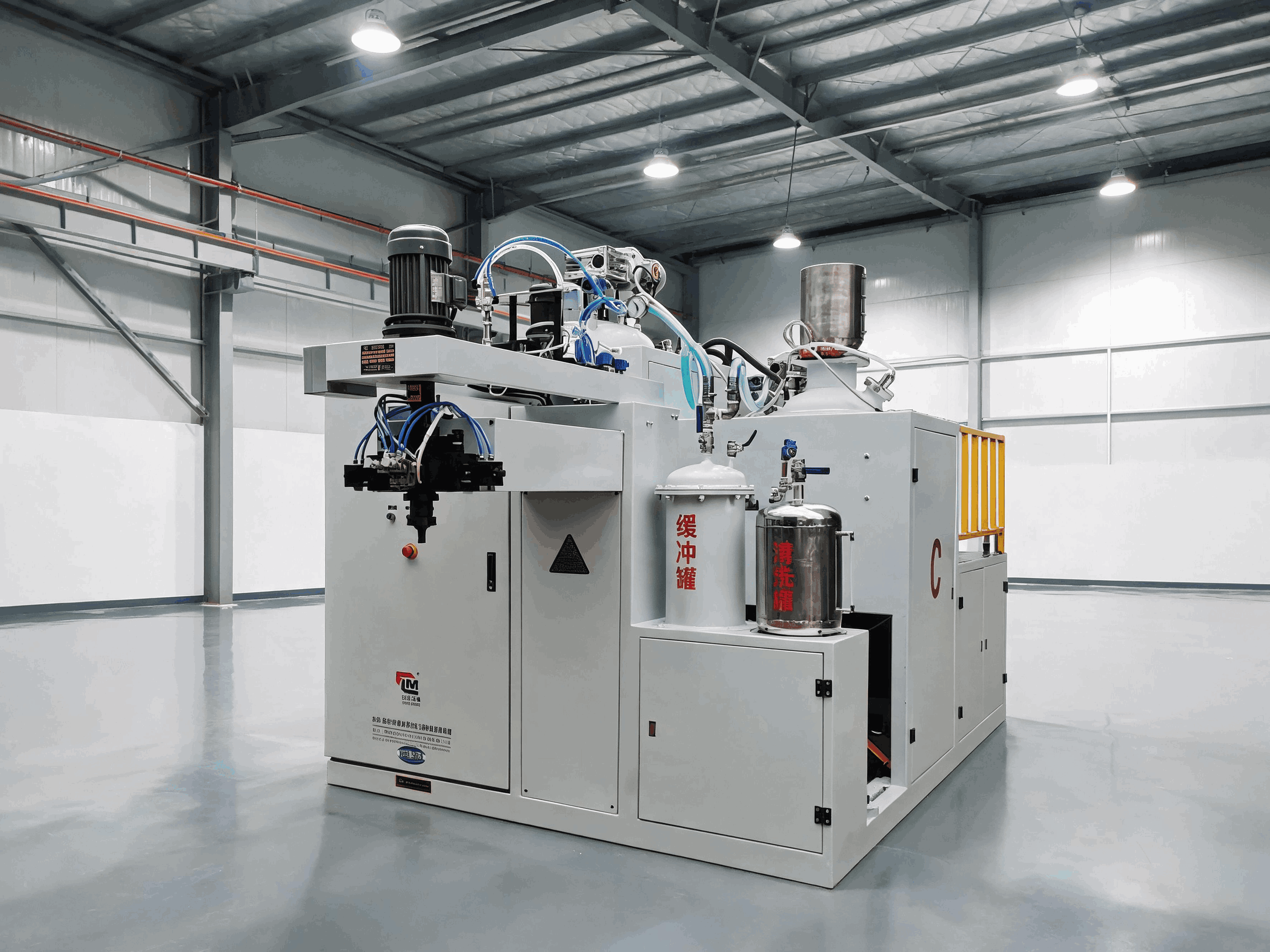
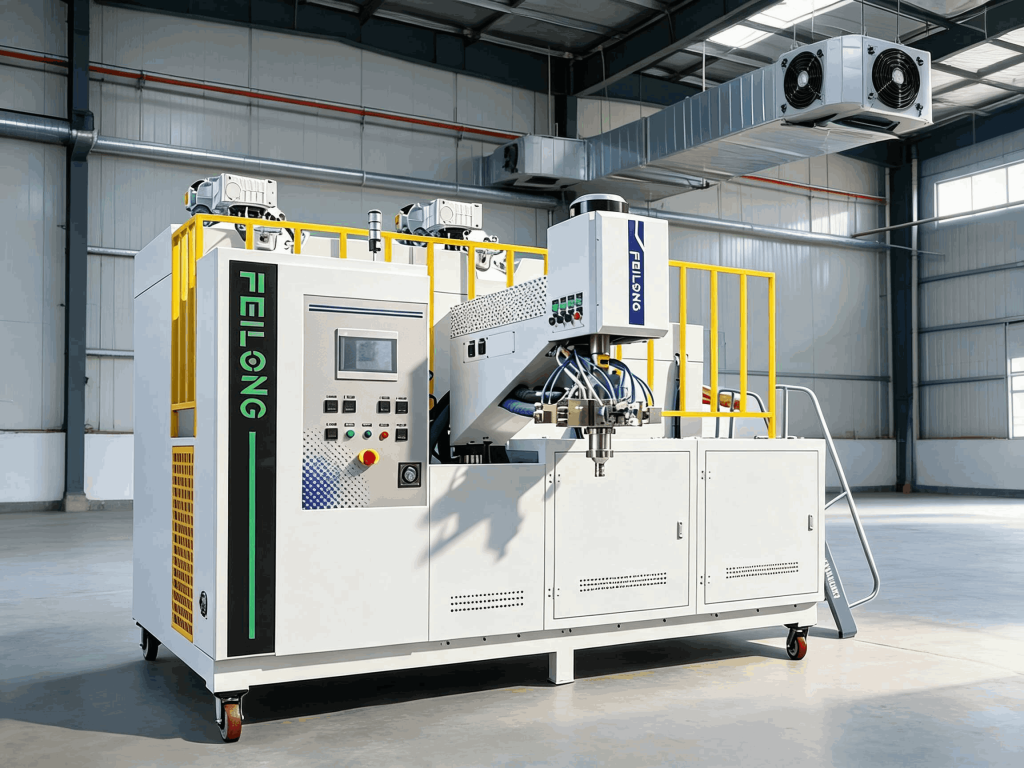
(Feilong Polyurethane Company – 3-component Elastomer Pouring Machine) ① Key technology: The pouring machine is a key equipment for producing pouring-type PU elastomer (CPU), the main technical performance lists as below: a. Accurate mixing ratio and stable measurement: employ thermostable and pressureproof high precision measuring pump and precise transmission system, adjustment and display unit. The measuring precision:±0.5% b. Even mixture and no air bubble: special designed high-speed mixing head to make primary liquid mixed evenly and no visual air bubble even when two group of primary liquid have large different value on viscosity and mixing ratio; still, it has features of easy adjustment and operation. c. Stable temperature control, accurate and reliable measurement: the temperature of primary liquid will affect its viscosity, pressure, mixing ratio and measuring accuracy, and may cause instable product quality. Especially, material B (MOCA) is solid under normal temperature, yet when temperature is too low, it will block and cannot process with it; otherwise, when temperature is too high, it will change its color and so affect the product quality. Usually, the primary liquid is heated by conducting oil circulation system with electric heating device; the measuring pump and pouring head are controlled on constant temperature by intelligent time-proportion digit display temperature controller. d. No visual air bubble on finish product: the vacuum defoaming process guarantee no air bubble in prepolymer, so also no bubble in two group of primary liquid in pouring head during mixing (it also relate to type of mixing head and tightness of pouring head). Employing an appropriate pouring method to guarantee there is no mechanical shock during pouring, so also no air bubble. ② Pouring process: add MOCA (melting point>110℃) into tank B, switch on the heating system for two group of primary liquid to make the temperature of group A and B reach required value and circulate respectively. While group A may processed with vacuum defoaming if necessary to guarantee there is no air bubble in prepolymer. Adjust the revolving speed and displacement of measuring pump according to compounding formula to guarantee appropriate mixing ratio of group A and B. Switch on the pouring switch to make group A and B mixed evenly in mixing chamber driven by high-speed mixing head, then pour the mixture into mould when there is no bubble in mixture in transparent tube (the mould and roller core have been pretreated and heated up to 90~110℃). When the interval between two pouring process is long enough (more than half of life in pot), it is necessary to clean and dry up the mixing chamber and mixing head by cleaning solvent (methylene chloride or trichlorethylene) (it is automatically controlled by computer). After pouring process, primary liquid A and B will automatically change to circulation state and return to respective tank. (3) Ageing and aftertreatment: ① Forming sulfuration (mould sulfuration). The roller need to treated with sulfuration process in mould before demoulding, the temperature of sulfuration should be a little bit higher under condition of no damage to its chemical constitution for the purpose of speeding up the chain extending and cross linking reaction and shortening demoulding time, as well as improving availability of facility and mould, normally, the temperature should be 100-120℃ for 30-120 minutes. ② After-sulfuration: the process of heating and sulfurizing after demoulding of roller. Its temperature should be a little lower than that of forming sulfuration, normal about 90-110℃ for 3-10 hours. ③ Surface machining: turn or grind on the machine tool according to specific requirements. (4) Precautions: ① Reasonable structured mould, reliable assembly, no glue leakage on parting surface and permitting air leakage. ② Balanced temperature, i.e. the temperature of mould, roller core and glue should be same, as well as the temperature of every part of mould should be same. ③ The pouring point for glue is on the edge of roller core or mould and should not be changed. The mould should be horizontally placed or declined slightly to let glue flow down along the wall for the purpose of avoiding air bubble. ④ The mould should not be moved arbitrarily until the demoulding strength for roller acquired for the purpose of avoiding fissuration. ⑤ When assemble the mould and roller core, pay more attention to avoid roller core coated with adhesive contacted with the inner wall of mould, otherwise, may affect the quality of adhesive bonding. In other words, the mould should not been stuck with adhesive and roller core should not been stuck with demoulding agent. ⑥ The roller, after sulfuration, is processed with surface turning and grinding when its strength permitted to guarantee the roughness and concentricity of roller. (5) Requirements for mould for CPU product: ① Material: During selecting material, pay attention to following matters: efficient strength and heat durability, good dimension stability, endurance, low cost. For mass production, it is commended to select metal considering endurance; while for single or trial production, to select non-metal (e.g. epoxy resin) mould, yet select metal mould in case of employing pouring of pressure matched moulds. ② Structure: except for geometric shape and dimension of product, pay still attention to pouring location, parting surface and exhaust for the following purpose: convenient for pouring and demoulding of product; guarantee the quality of product surface; convenient for exhaust of gas in mould chamber; convenient for making and machining of mould and reduce cost of mould.
(6) Main factors affect performance of PU roller: ① Effects of polyol molecular weight at performance of roller: The molecular weight of polyol decides the density of characteristic ionogen in PU elastomer. For polyester type, the physical property may improve when molecular weight increase; while for polyether type, the flexibility may improve yet tensile strength and modulus will decrease when molecular weight increase. Normally, the molecular weight should be 1100-2200. ② Effects of percentage content of prepolymer isocyanate group (NCO): When NCO increase, the hardness, tearing toughness, stress at elongation and tensile strength will improve yet the viscosity of prepolymer will decrease, so it is easy for defoaming and mixture, as well as the specific elongation will decrease. However, the NCO should not be too high, otherwise, the curing velocity of glue may over high and cause shortening the life in pot, and this is disadvantage to pouring process. Normally, the content of NCO should be 2.4-6.5%.
③ Effects of chain extending coefficient: The equivalence ratio at amine curing agent against NCO in prepolymer (NH2/NCO) affects significantly the physical property of glue. Normally, the value should be 0.85-0.95%. For MOCA cross linking, the NCO should be a little bit higher to make the elastomer product has an appropriate degree of crosslinking. When the chain extending coefficient is 0.88, a balance between chemical crosslinking and physical crosslinking will achieve, and best comprehensive performance for elastomer obtained. When the data is 1 or more, the strength will drop evidently and permanent deformation will increase because of plasticization effect of MOCA and decrease of chemical crosslinking and hydrogen chain. ( Normally, the chain extending coefficient should be 0.85.) ④ Effects of mixing temperature: The production processes (e.g. mixing temperature) should be different as employing different prepolymer or chain extending agent. When mixing temperature increase, the life in pot and gelation time will decrease. Yet, too low temperature is not permitted for solid chain extending agent even though it is benefit for improving life in pot and physical performance, still may cause difficulty in defoaming and even mixture (because of high viscosity). It is appropriate to keep the temperature within the limit of no liberation of chain extending agent in prepolymer, e.g. for MOCA, the data should be 110-120℃. ⑤ Life in pot: Two primary liquid of CPU will react—chain extending and polymerizing–when meet with each other, and the mixture will lose its fluidity gradually. Usually, we define the life in pot (also called as workable time) as the time interval from mixing of two group of liquid until the mixture loses its fluidity on the whole. The gelation time can be extended and so production process improved when add methyl methacrylate (MMA) about 5-15% weight of prepolymer into MOCA.
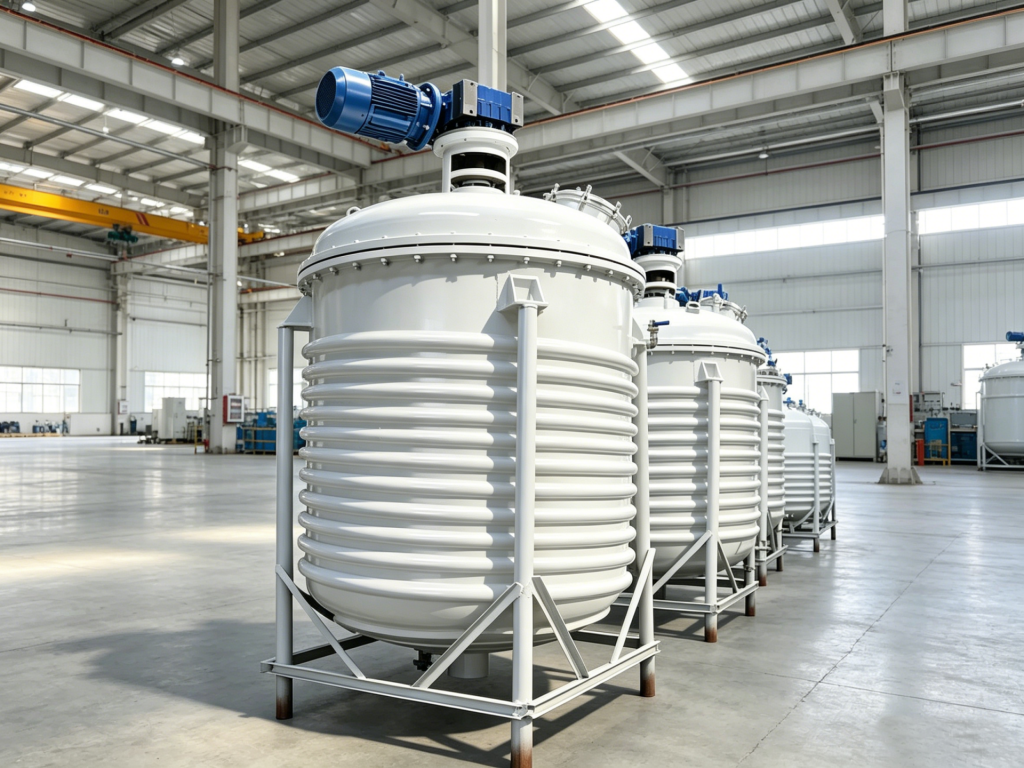
Ⅲ. Main equipments: 1.Reaction pot: used for dehydration of polyol, formation of prepolymer and defoaming.
(Feilong Polyurethane Company – Reactor) It can employ two-layer pot with stainless steel inner bladder, equipped with heating or cooling jacket, anchor-type blender, conduction oil circulation system heated by electricity, temperature control system, vacuum buffer tank and vacuum pump system. The pot also has holes for incoming and outgoing of primary liquid, inspection, temperature and pressure measurement, vacuum and air exhaust, as well as vacuum pumping. The capacity of pot is decided by output required, usually, the capacity and dimension are listed as following: 80L(φ400×500);120L(φ500×500);200L(φ600×700). Usually, the vacuum pump employs doublestage, spiral slice type. Its bleed air rate is 8-15L/s. For energy saving and rapid increase/decrease of temperature, it is necessary to equipped with cold oil cabinet, heat exchanger, hot oil cabinet, vacuum buffer tank, and vacuum pump (2X-8A or 2X-15A). 2.Pouring machine: as CPU has such features as short life in pot, high gelation velocity, large use of glue for single product, so it can only been produced by pouring machine for high quality glue roller. Let us introduce our Model CPU20F high-temperature pouring machine for PU elastomer as below:
(Feilong Polyurethane Company – 3-component Elastomer Pouring Machine) (1) Raw material circulation method in every system: ① The complete circulation of raw material(material tank—measuring pump—switch valve of pouring head—material tank) to make the temperature of material evenly and flow rate stably. ② The material tank can fed with dry nitrogen to prevent the primary liquid mixed with moisture and deteriorate. The reflow port for circulation of primary liquid is on the bottom of tank, so no air bubble will be taken in. ③ Balance the pressure of circulation and output (equipped with reliable throttling device and precise pressure-adjusting device) can improve the precision of mixing ratio and stability of output. (2) High precision measuring system: ① Employing high-hardness, low speed precise measuring pump that is resistant to high temperature and pressure, with accurate and stable flow rate. ② Employing high-precision mechanical speed transmission or frequency control device to adjust the mixing ratio and flow rate of every group of liquid, with advantages such as flexible, convenient and stable. ③ High precision can be guaranteed by large range of revolving speed adjustment even when the output is small or viscosity is low. (3) High-efficiency advanced-designed pouring head: ① Every group of primary liquid will synchronize rapidly when changing from circulation state to output state, and no advancing or lag occur. ② Equipped with high precision throttling device and reflow adjusting device to make the pressure of circulation and output balanced, so the precision of mixing ratio improved and product quality guaranteed. ③ The special purpose and long tested mixing head can mix evenly two groups of primary liquid and no air bubble produced even when they have large difference in viscosity and mixing ratio. It also can rapidly exhaust gas in mixing chamber, so the loss of primary liquid is very little when starting pouring. ④ Employing specially designed rotary shaft seal unit, no material backflow, with features of reliable lubrication and easy to change spare parts. ⑤ The switch valve employs precisely machining polytetrafluroethylene (PTFE) seal, with features of convenient adjustment and no heat deformation. ⑥ The pneumatic cleaning switches exclusively used for two group of primary liquid can control the cleaning solvent for mixing chamber and compressed air go out through throttling hole of material, and it will not block and no backflow of mixture. (4) Advanced, reliable and stable control and electric system: ① The MCU control the pouring and cleaning process, with features of easy operation and maintenance, simple and clear circuit, low failure rate. ② Employ intelligent time-proportion digit display temperature controller and platinum resistor probe (PT100) to control the temperature of primary liquid A, medium A, primary liquid B, medium B, measuring pump B and pouring head. So it has features of accurate and reliable control, easy to read out data and adjust them. ③ The pressure of primary liquid been displayed digitally, and equipped with overpressure alarm device, the flow rate and revolving speed of mixing head also can been displayed digitally. 3. Heating unit for mould and roller core:
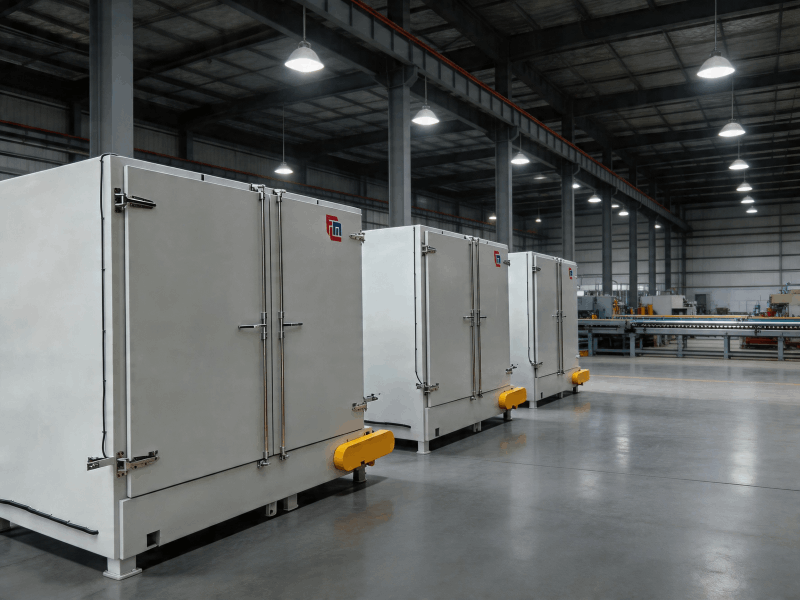
(Feilong Polyurethane Company – Energy-saving Hot Air Circulating Oven) An appropriate heating unit is designed according to size of mould and roller core. Usually, it is a far infrared electric heater with temperature controller. It can heat up the temperature of mould and roller core to 90±10℃.
References: 1.Polyurethane Elastomer, C• Happubin(U.K.), translated by Yan Jiabin, published by Liaoning Science and Technology Press, Nov. 1985. 2.Handbook of Polyurethane, Chen Shuangfei (U.K.) Imperial Chemical Industry Co., published by Information section of Chemical Industry Institute of Jiangsu Province, Oct. 1989. 3.Polyurethane Resin, Li shaoxiong and Zhu Luming, published by Science and Technology Press of Jiangsu Province, Mar. 1992. 4.Handbook of Polyurethane, G• Errtel, translated by Yan Jiabin and Lu Shuoxian, published by China Petrochemical Industry Press, Nov. 1992. 5.Handbook of Polyurethane Elastomer, Chemical Industry Institute of Shangxi Province, published by Chemical Industry Press, Mar. 2001. Introduction to author: Chen Xinshi, formerly engaged in mechanical design for chemical industry in Beijing Design Institute, Ministry of Chemical Industry; and specialized in design, research and development of PU equipment from 1972 till now. He has issued more than 100 papers on polyurethane technology, e.g. Eighteen Questions About Production & Technology of Polyurethane Joint-upper Shoes and Soles, Eleven Questions About Selection of Pouring Machine for Pour-type PU Elastomer, The Development & Prospect of Home-made Forming Machine for PU Soles, How to Select Moulding PU Equipment, Ninety-five Questions About Production & Technology of PU Elastomer, etc. He is member of Editorial Board of Polyurethane Industry as well as Polyurethane and Elatomer. Note: this paper has been published on the Eleventh Annual Conference of China Polyurethane Industry Association and the Second Symposium on Technology of Rubber Product in China. And it has received good remarks from experts attended meeting as it plays an import role to popularize and improve polyurethane elastomer technology in China, and contribute to catch up with the advanced world level.

 FEILONG PU MACHINE