Search the whole station
Wenzhou Feilong Polyurethane Equipment Engineering Co., Ltd.
Chinese website: http://www.pumcn.com/
English website: https://www.flpumachine.com/
The polyurethane flexible foam layer on the back of a carpet may look like a simple soft pad, but it actually performs several critical functions: locking the pile roots to prevent fiber pull-out, providing resilience underfoot, absorbing impact and noise, stabilizing carpet dimensions, and improving anti-slip and abrasion performance. Whether this foam layer has uniform thickness, fine cells, and firm adhesion to the substrate directly determines the hand feel, service life and installation quality of the carpet.
In industrial production, there are three main coating routes for PU backing foam: knife coating, film transfer and indirect coating. All three can produce a finished product, but their equipment structure, process window, cost structure and final quality characteristics are completely different. Many companies compare only quotations during line planning, and only after installation do they discover that thick coatings crack, thin coatings are unstable, product changeovers are hard to clean, or line speed simply cannot be raised. Let us examine all three in detail.
1. Principle Differences of the Three Processes
1.1 Knife Coating (Direct Coating)
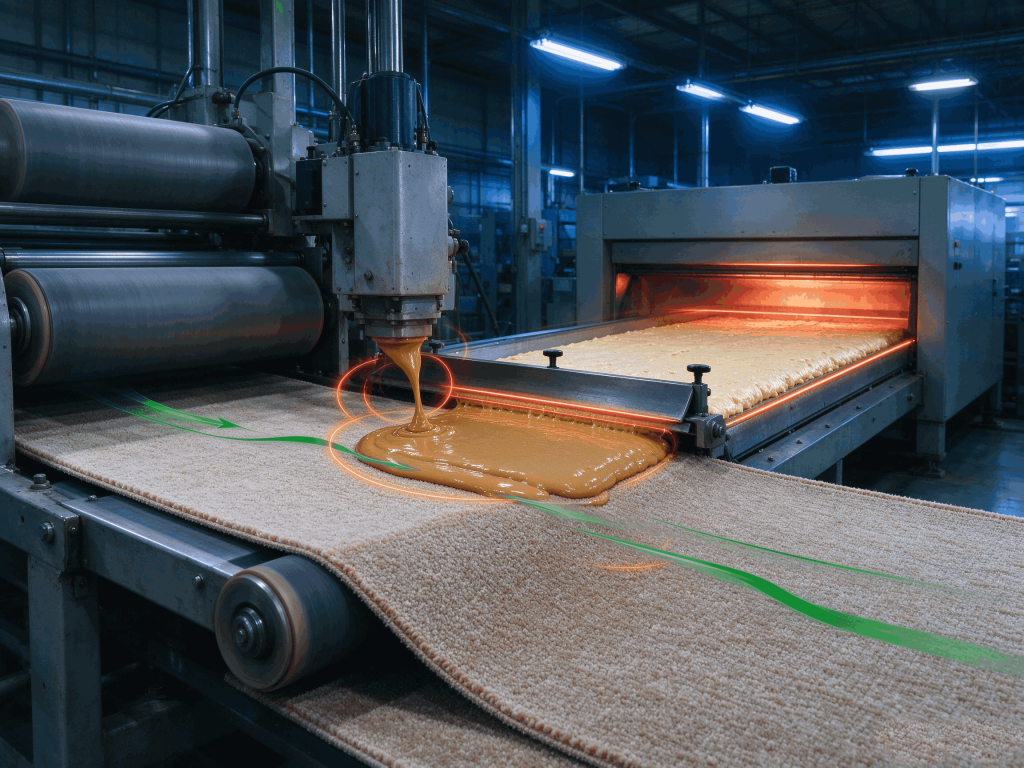
The foaming mix is poured from the casting head directly onto the back of the carpet, metered by the gap between the doctor blade and the backing roller to control coating thickness, then enters the oven for foaming, gelling and curing.
The key point is that the material contacts the substrate directly, so the coating penetrates into the pile roots and backing structure, forming mechanical interlocking adhesion. The equipment chain is short: a foaming machine, a blade frame and an oven are enough to form a line.
1.2 Film Transfer Coating
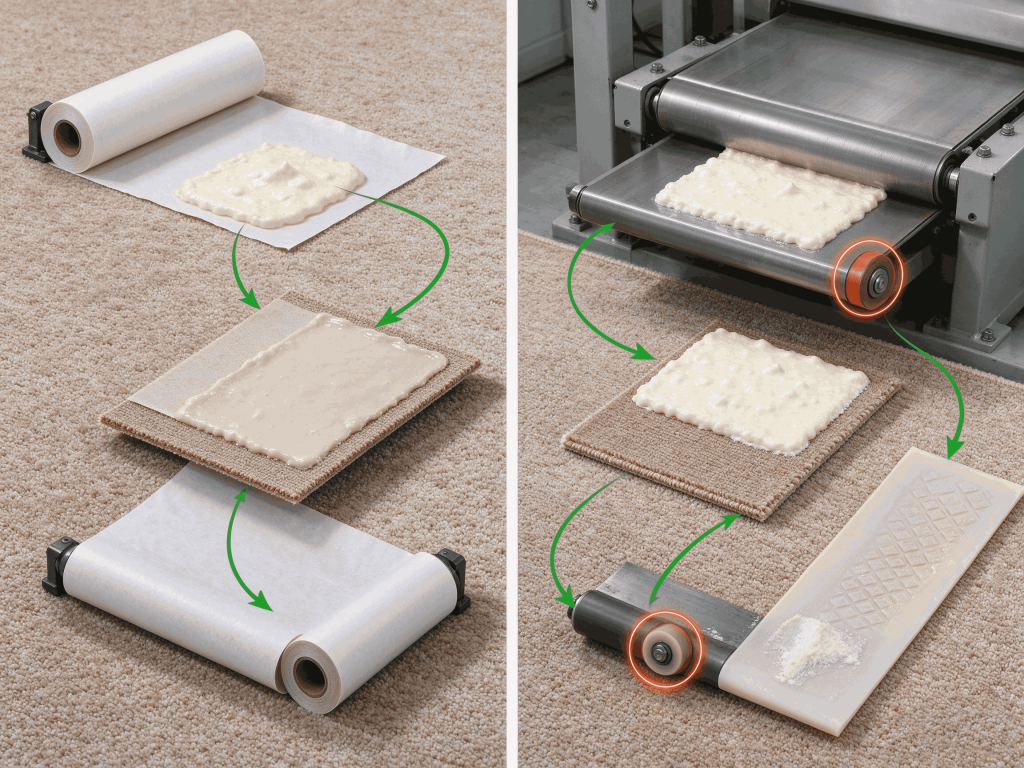
The foaming mix is first poured onto release paper or release film, metered into a film by a doctor blade or roller on the release carrier, then foamed and gelled in the oven to a semi-cured state, and finally nipped against the carpet back at the laminating roller to complete the transfer. The release paper is stripped off and rewound for reuse.
Essentially, a well-formed foam layer is built on a flat carrier first, then laminated onto the carpet as a whole.
1.3 Indirect Coating
The foaming mix is applied onto a circulating carrier such as a steel belt, silicone belt or large-diameter drum, where foaming and partial gelling take place on the carrier surface, and is then transferred to the carpet back in a wet or semi-gelled state. The carrier is cleaned and recirculated. The difference from film transfer is that no release paper is consumed; the carrier belt itself circulates, and an embossing roller is often included to create a textured surface on the backing.
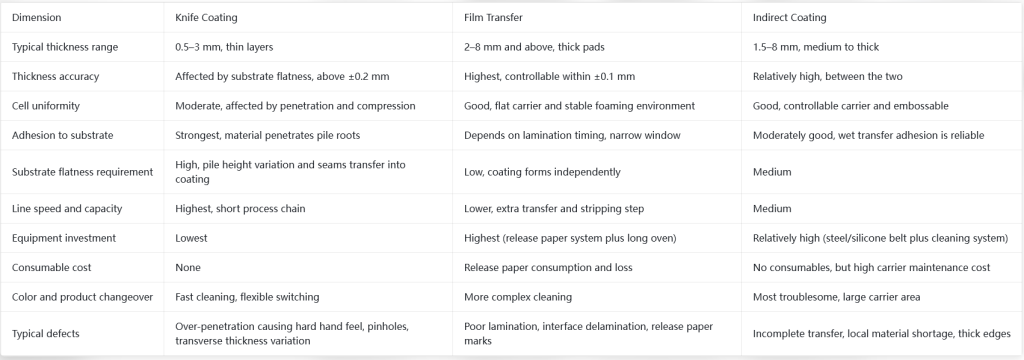
2. Side-by-Side Comparison Across Seven Dimensions
3. Knife Coating: Best Value, Weak on Thickness Consistency
The biggest advantages of knife coating are adhesion and efficiency. In the wet state the material is pressed directly into the carpet back and penetrates the pile roots to form an anchor, so peel strength is naturally superior. It is very suitable for thin backing layers such as residential carpet tiles, automotive interior carpet and exhibition carpet. The process chain is short, the oven load is low, line speed can be pushed relatively high, and both energy consumption and investment are favorable.
Its weakness is equally clear: coating thickness is effectively a replica of the substrate. If pile height fluctuates or the backing has seams and wrinkles, no matter how precise the blade gap is, the final thickness will follow the substrate contour. The result is transverse thickness variation, insufficient resilience in thin areas and a hard hand feel in thick areas.
Blade pressure is also a parameter that must be balanced. Higher pressure produces a thinner coating and better penetration, but excessive compression collapses the foam structure, raises density and reduces resilience, which operators often describe as a dead or lifeless product. Insufficient pressure leads to thickness deviation and blade marks on the surface.
From shop-floor experience, four things must be held stable in knife coating: constant substrate tension, blade gap and backing roller concentricity, stable material viscosity and temperature, and an oven temperature profile matched to the gelling rhythm. If any one drifts, thickness variation appears immediately.
4. Film Transfer: Highest Accuracy Ceiling, at the Cost of Consumables and Timing Control
Film transfer separates forming from lamination. The foam forms independently on release paper, free from interference by the carpet surface, which gives the best thickness accuracy, surface flatness and cell fineness of the three processes. For thick pads, high-resilience products and premium commercial carpet requiring a surface texture, film transfer is clearly advantageous.
But this route has two hard constraints.
The first is cost structure. Release paper is a continuous consumable. The paper’s own flatness, heat resistance and release performance directly determine yield, and paper loss and replacement costs accumulate over time. The equipment also requires an additional unwinding, laminating, stripping and rewinding system, plus a longer oven, so investment is clearly higher than knife coating.
The second is a very narrow lamination timing window. The foam is only suitable for nipping when it reaches a semi-gelled state on the release paper. If too wet, the foam is deformed during nipping, and bubbles and material shortage appear at the interface. If too dry, the surface has already skinned over, leaving only physical contact with the carpet backing, so peel strength is insufficient and delamination or blistering appears after a period of use. This window is typically only a few seconds to a dozen seconds, held by the coordinated action of line speed, oven temperature and laminating roller pressure, which demands high precision in operation and temperature control.
The most direct way to judge whether film transfer is running well is a peel test plus cross-section observation: whether the foam at the interface is continuous, whether there is an obvious dense skin, and whether peeling tears the foam or detaches the whole layer. Whole-layer detachment means the lamination timing has already passed.
5. Indirect Coating: A Balanced Option for Continuity and Thickness
Indirect coating sits between the other two. It uses a circulating carrier (steel belt, silicone belt or large drum) to carry the foam, which is shaped on the carrier and then transferred to the substrate. It combines controllable thickness with reliable adhesion, and consumes no release paper, so long-term running cost is lower than film transfer.
Its core strengths are twofold. First, it can produce thick pads while keeping the cross-section regular. Second, the carrier surface can be textured, so an embossing roller can leave a raised or recessed pattern on the backing, eliminating a downstream embossing step. For automotive carpet and hotel commercial carpet where underside appearance and thickness are specified, indirect coating is common.
The tradeoff is maintenance. The carrier belt has a large area and runs hot continuously, so cleaning and upkeep are essential tasks. Residual gelled crumbs and carbonized deposits on the belt surface print directly onto the next roll of carpet as regular spots, and belt tracking deviation causes transverse thickness variation. Therefore the shutdown cleaning cycle, belt surface temperature uniformity, and tensioning and edge-guiding systems must all be planned in advance.
Another common problem is incomplete transfer. If the foam over-gels on the carrier, only part of it transfers, leaving local material shortage and exposed substrate, along with thick edges. This is essentially a mismatch between gel degree and transfer roller pressure, following the same timing logic as film transfer, just with a different carrier.
6. Common Defects and Process Attribution
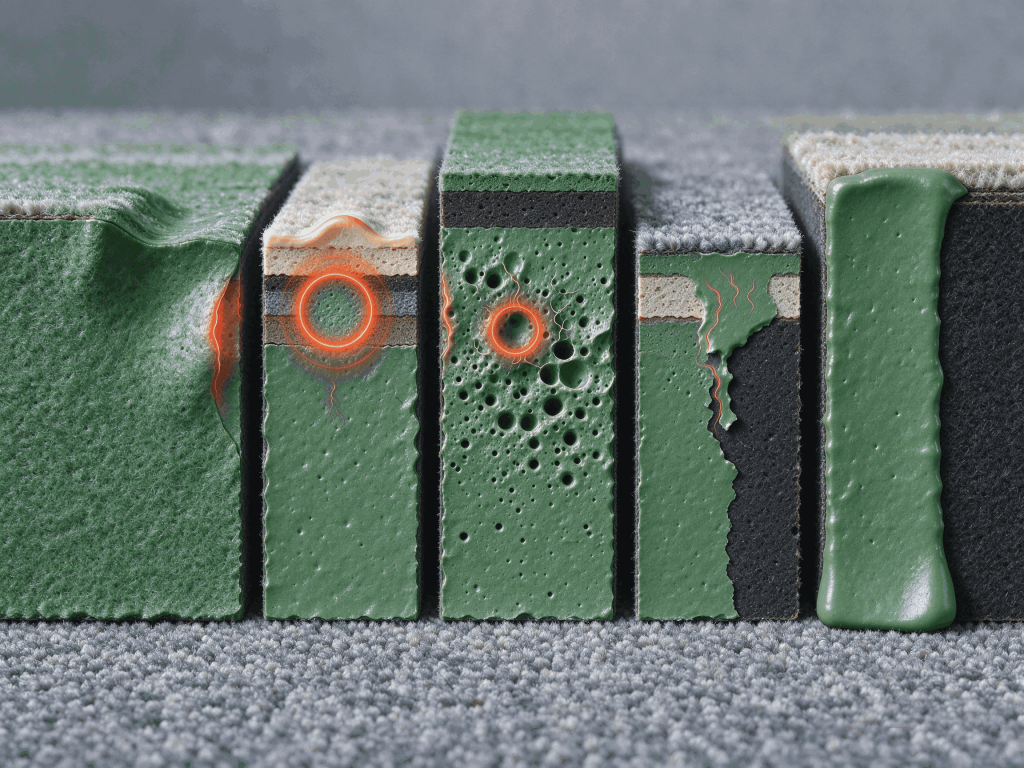
Classifying shop-floor problems by process greatly improves troubleshooting efficiency:
Transverse thickness variation: For knife coating, check substrate tension and blade concentricity. For indirect coating, check belt tracking and belt surface temperature. For film transfer, check the gap between blade and carrier.
Hard hand feel and poor resilience: Usually over-penetration or compression in knife coating. Check blade pressure and material viscosity.
Interface delamination and blistering: Lamination or transfer timing issues in film transfer and indirect coating. Check gel degree and nip pressure.
Regular spots and marks: Inadequate carrier belt cleaning in indirect coating, or excessive reuse of release paper in film transfer.
Pinholes and collapsed cells: Possible in all three. Check air injection at the mixing head, material degassing, and excessive heating rate in the first oven zone.
Thick edges: Edge guards and pressure roller setup in film transfer and indirect coating.
7. Selection Guide
Choose knife coating when: products are mainly thin backing layers (0.5–3 mm), substrate flatness is stable, line speed and return on investment are priorities, product changeovers are frequent, and the portfolio is mainly residential and exhibition carpet.
Choose film transfer when: thickness accuracy and surface quality come first, thick or high-resilience premium commercial carpet is involved, release paper is needed to impart a surface texture, capacity pressure is moderate, and consumable costs are acceptable.
Choose indirect coating when: medium to thick backing is required, a regular cross-section with an embossed pattern is specified, long-term release paper consumption should be avoided, and a maintenance team can guarantee carrier belt upkeep.
In practice, many companies build combination lines, for example knife coating for the main backing with indirect coating for local thickening. This places higher demands on the metering and switching capability of the foaming machine.
8. Summary
No one process is absolutely superior; only fit matters. Knife coating wins on adhesion and efficiency and loses on thickness consistency. Film transfer wins on accuracy and surface quality and loses on cost and timing window. Indirect coating is the balance point between them, winning on continuity and texture capability and losing on maintenance complexity.
What actually determines yield is often not which route was chosen, but whether the key parameters on that route are held stable: whether material temperature and mix ratio are constant, whether the foaming machine’s metering and mixing are reliable, and whether the oven temperature profile matches the gelling rhythm. The process route is the skeleton; equipment stability is the flesh and blood.
Wenzhou Feilong polyurethane foaming equipment can supply matched foaming units, metering systems and temperature control solutions for all three routes — knife coating, film transfer and indirect coating — adapted to continuous production of carpet backing flexible foam, helping manufacturers hold parameters steady on their chosen route and reduce thickness variation and interface defects.
 FEILONG PU MACHINE