Search the whole station
Wenzhou Feilong Polyurethane Equipment Engineering Co., Ltd.
Chinese website: http://www.pumcn.com/
English website: https://www.flpumachine.com/
Polyurethane forklift wheels and load wheels are widely used in warehousing, ports, mines and factory handling lines. Many buyers and process engineers share one question: if both are PU wheels, why are nearly all heavy-duty forklift wheels made by casting instead of faster injection molding? Although their appearance may look similar, service life, load resistance and impact tolerance differ sharply under real working conditions.
Injection molding suits high-volume, thin-walled, standardized small parts. Casting is preferred for heavy-load, high-wear, thick-section industrial load wheels and forklift wheels. Below we compare the two processes from raw material chemistry, mechanical performance, forming limits, customization and long-term operating cost.
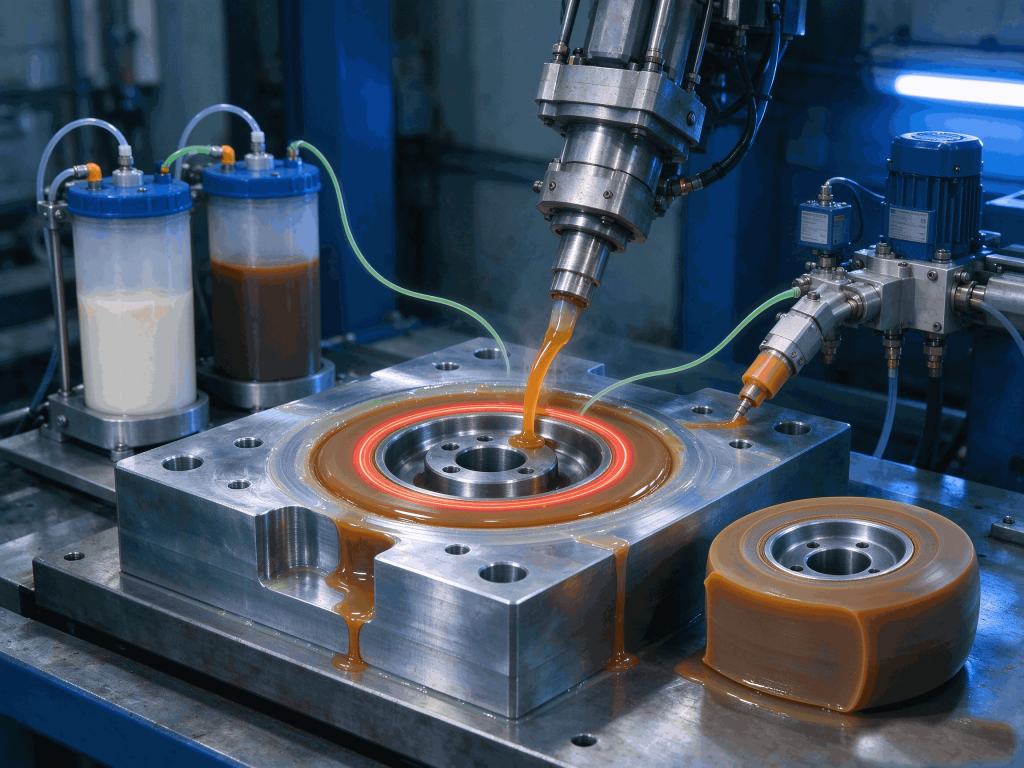
1. Raw Material Systems Set the Performance Ceiling
Injection molded polyurethane generally refers to TPU, thermoplastic polyurethane. It melts when heated and solidifies on cooling, and can be re-melted for recycling with relatively low crosslink density.
Cast polyurethane (CPU, cast polyurethane elastomer) is a reactive two-component or multi-component system. Prepolymer reacts with chain extender to form irreversible chemical crosslinks, creating a thermoset elastomer.
The crosslinked structure delivers superior cohesion, tear strength and cut resistance — critical properties for heavy-duty forklift wheels. Under repeated crushing by sharp debris and edge impact, cast wheels resist chipping and chunking far better.
2. Load Capacity, Wear and Impact Resistance
2.1 Load Bearing Performance
Injection molded TPU wheels work well for light-load, low-speed applications. Thick-section heavy-duty wheels made by injection molding develop large internal stress from uneven cooling. Under sustained pressure, they tend to deform and bulge over time.
Cast parts cure gradually with ample stress relief inside thick cross-sections. Cast forklift wheels show much lower permanent compression set under continuous heavy load and are less likely to collapse under load.
2.2 Abrasion Resistance
At the same hardness, cast CPU delivers far better abrasion resistance than standard injection TPU. In mines and factories with frequent pallet traffic, service life of cast wheels can be several times longer.
2.3 Tear and Cut Resistance
Metal shavings, burrs and gravel are common on workshop floors. Once an injection TPU wheel is cut, cracks easily propagate under load. The crosslinked structure of cast PU helps stop crack growth and improves resistance to nicks and gouging.
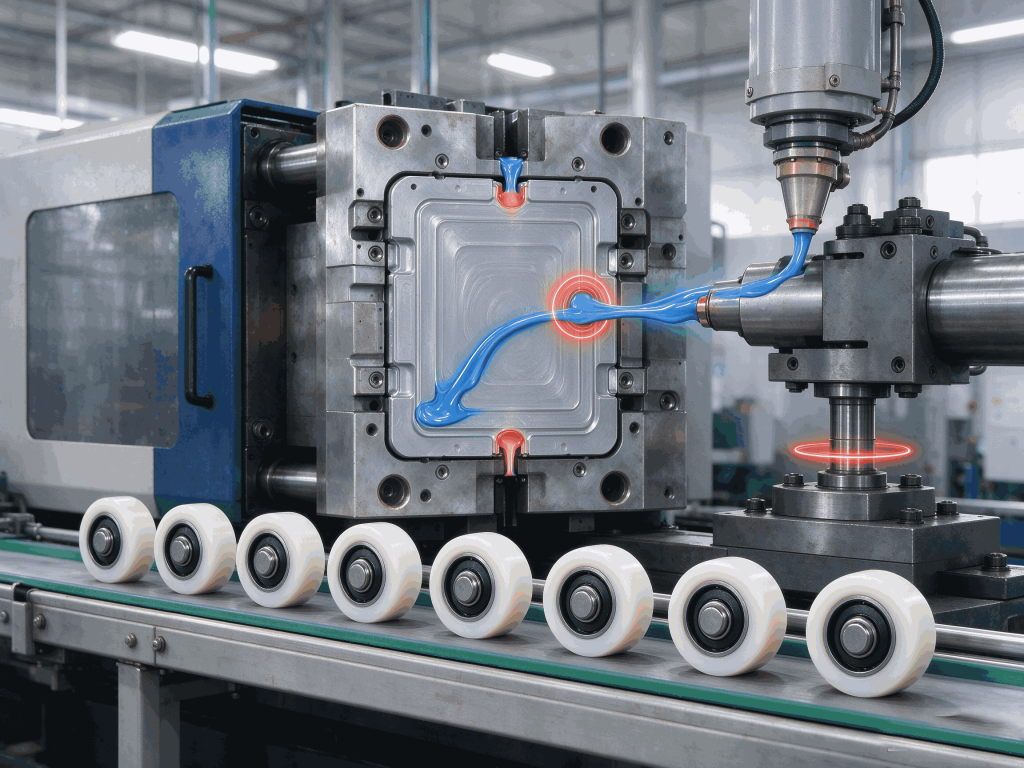
3. Wide Hardness Tuning Range for Diverse Working Conditions
Injection TPU is limited by its material grade; each grade offers only a narrow hardness window and requires full material change to shift hardness.
With casting, hardness can be adjusted freely across a wide range by tuning the ratio between prepolymer and chain extender. Soft rollers and ultra-hard heavy-duty wheels can both be produced on the same casting machine simply by switching formulations, ideal for mixed-specification orders.
4. Flexible Size, Section Thickness and Customization
Injection molding is constrained by mold clamping force and melt flow. It struggles with large-diameter, thick-bonded wheels; thick injection parts often suffer from internal shrinkage, voids and cold lines.
Casting uses low-pressure feeding with gentle material flow, suitable for large-diameter, thick-coated forklift wheels. Non-standard oversized wheels, custom hub bonding and irregular load wheels are easier to manufacture. Casting also lowers mold investment and speeds up revisions for small-batch custom orders.
Casting does have tradeoffs: cycle time is longer than injection molding. It demands strict control of material temperature, mixing ratio and curing, relying on reliable casting equipment and experienced operators. For mass production of simple small standard wheels, injection molding holds the advantage in unit throughput.
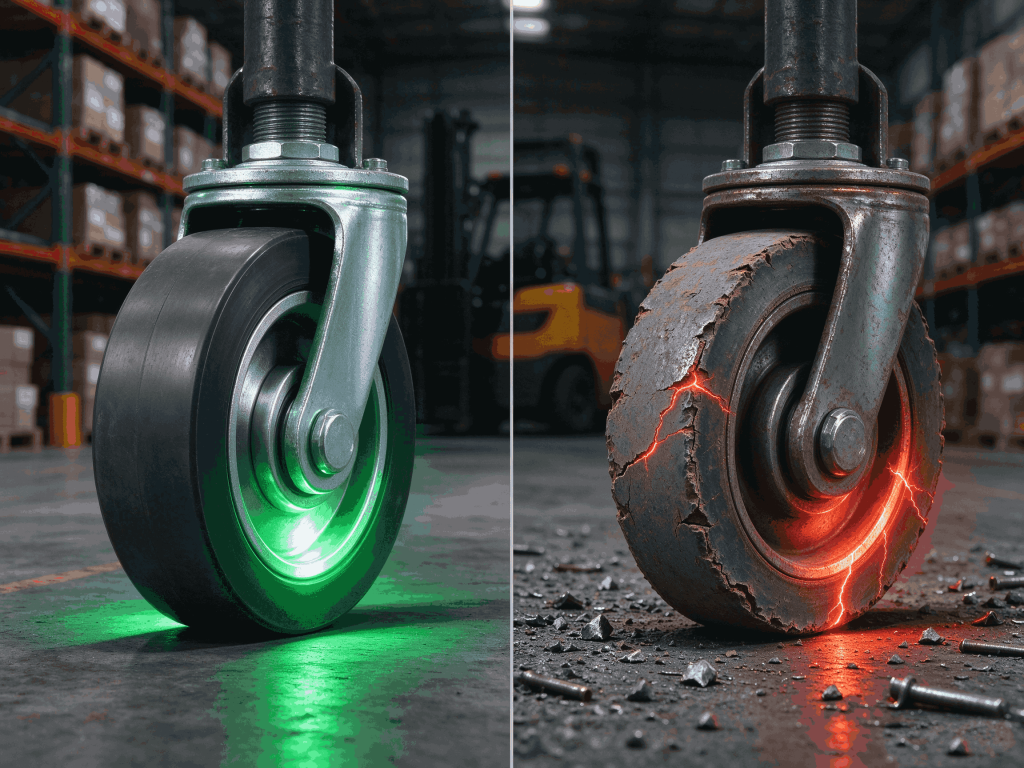
5. Total Cost of Ownership: Look Beyond Unit Price
Injection molded wheels often carry a lower upfront price for the same size. However, industrial wheels should be evaluated by cost per load-mile.
Cheaper light-load injection wheels wear and deform quickly under heavy duty. Frequent wheel replacement, downtime and labor for disassembly raise overall expenses. Although cast wheels cost more at purchase, they run longer with fewer failures and reduce forklift downtime, delivering better economic value over the long term. Many forklift factories and logistics fleets eventually switch heavy-duty wheels to cast PU.
6. Quick Selection Guide
✅ Choose casting: Heavy-duty forklift drive wheels, mine load wheels, large thick-coated wheels, applications requiring excellent tear and cut resistance, non-standard custom sizes, continuous heavy compression.
✅ Choose injection TPU: Light-duty small wheels, large batches of standard simple parts, low impact, projects prioritizing low unit price.
Summary
Casting does not replace injection molding. It unlocks performance levels difficult to achieve by injection molding for heavy-duty industrial wheels. For forklift and load wheels, the core requirements are wear resistance, tear strength, low compression set and impact tolerance — exactly where cast CPU elastomer excels.
Stable casting equipment and mature process control are essential to fully realize the material’s potential. If you are developing custom heavy-duty wheels, the cast route is usually the more reliable solution.
 FEILONG PU MACHINE