 FEILONG PU MACHINE

Polyurethane Carpet Backing Production Process and Equipment
Http://www.PUmcn.com
To improve walking comfort and reduce footstep noise, tufted carpets require a backing layer. Foamed rubber latex materials or PVC plastics were widely used in the early stage. In recent years, flexible polyurethane foam has been extensively adopted as the carpet backing material.
Its advantages are as follows: it delivers excellent shock absorption, comfort, aging resistance and moisture resistance; it can be cleaned with common solvents and detergents. The good water absorption of flexible foam ensures that no water separates out from the backing, so water stains, which commonly occur with latex foam products, will not form. When carpets are coated with polyurethane, a large amount of water will not evaporate as in rubber latex coating. This helps improve the working environment and cuts energy consumption during coating, making the processing process relatively cost-effective.
1. Formulation
Its raw materials and formula are similar to those of conventional flexible polyurethane foam.
(1) Raw materials
① Polyether polyol: tri-functional polyether with molecular weight above 3000; high-molecular-weight, high-activity polyether; polymer polyol (grafted polyether). ② Polyisocyanate: TDI; polymeric MDI; modified MDI. ③ Catalysts: organotin catalysts such as dibutyltin dilaurate; tertiary amine catalysts such as triethylenediamine. ④ Cell stabilizer: silicone foam stabilizer. ⑤ Blowing agents: F-11; water. ⑥ Fillers: 20 to 30 percent inorganic fillers are added to increase hardness and reduce costs, such as chalk, dolomite, aluminum hydroxide, barite and so on.
(2) Basic Formula
Polyether (hydroxyl value 56) 100
Organotin catalyst 0.1~0.3
Triethylenediamine 0.2~0.5
Silicone cell stabilizer 1~2
Water 2~4
F-11 0~20
Filler 20~30
Isocyanate index 105
(3)Properties
①Main Properties:
Density (kilograms per cubic meter) 32 to 52
Compression set (percent) 3 to 5
Compression modulus (at forty percent compression) (kilopascals) 2 to 2.5
Tear strength (kilopascals) 44 to 53
Tensile strength (kilopascals) 90 to 120
Elongation at break (percent) 200 to 250
Rebound resilience (percent) 41 to 46
Indentation hardness (megapascals) 2.5 to 2.9
②Notes:
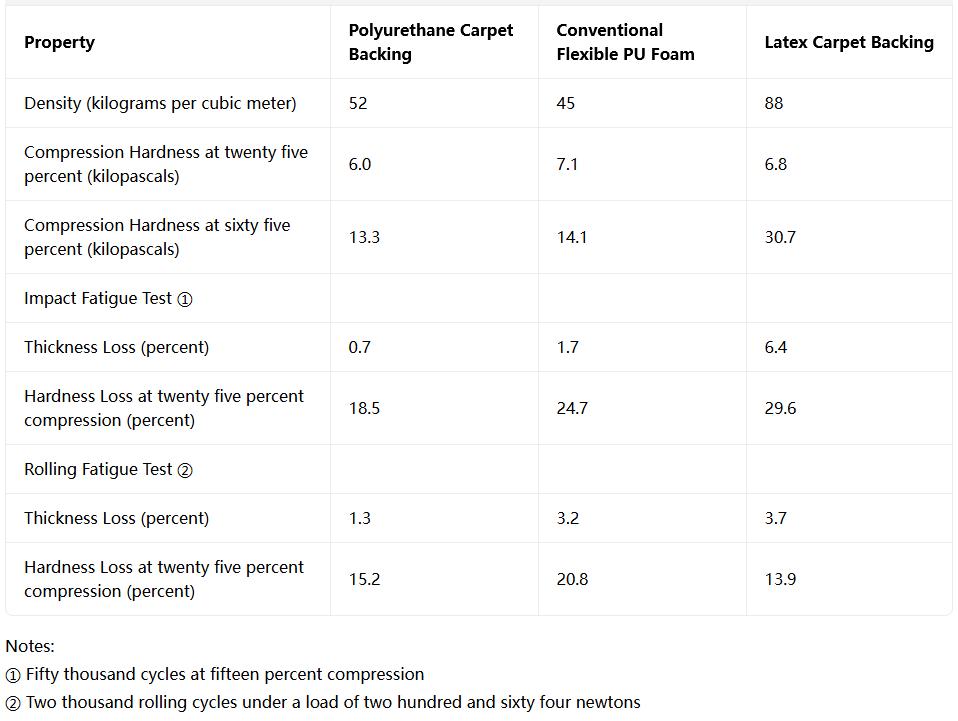
The hardness of foam can be increased by adding inorganic fillers or raising the isocyanate index, while the fatigue resistance will decrease significantly. If it is required to improve the compression hardness of foam without reducing fatigue resistance, the proportion of polymer polyol in polyether can be increased. This means adding organic fillers, which will raise the cost.
③ Performance Comparison of Industrial-Grade Carpet Backing.
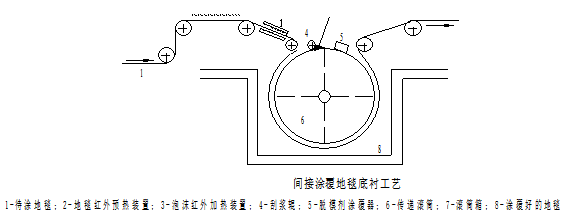
The reactive mixture, delivered by a transversely reciprocating spray pipe from the casting head, is applied onto a large roller coated with release agent. A doctor blade spreads the mixture to the required thickness.
The carpet, pre-dried by an electric heater, is then immediately bonded onto the still non-flowing liquid reactive mixture. Heating triggers foaming and expansion of the reactive mixture to achieve adhesion to the carpet. The coated carpet is removed from the conveyor system, cooled and trimmed to obtain the finished product.
三. Equipment
(I)Basic Requirements
Carpet running speed less than 3 millimeters per minute; width 1.25 meters; foam forming thickness from 3 to 4 millimeters. The production capacity reaches 180 meters per hour. Based on 20 production hours per day, the daily output is 3600 meters, equivalent to 4500 square meters. According to relevant data and tests, the preferred density ranges from 200 to 250 kilograms per cubic meter, namely 0.2 to 0.25. Therefore, each square meter of backing requires 0.6 to 1 kilogram of raw materials. If the daily output is 3600 square meters, the raw material consumption is 2.16 to 3.6 tons. To save raw materials and increase the viscosity of the mixture, 30 to 50 percent inorganic fillers such as calcium carbonate can be added. This can reduce raw material consumption by 0.7 to 1.8 tons per day. With the raw material price of 15 thousand yuan per ton, the daily cost saving can reach 10 thousand to 27 thousand yuan.
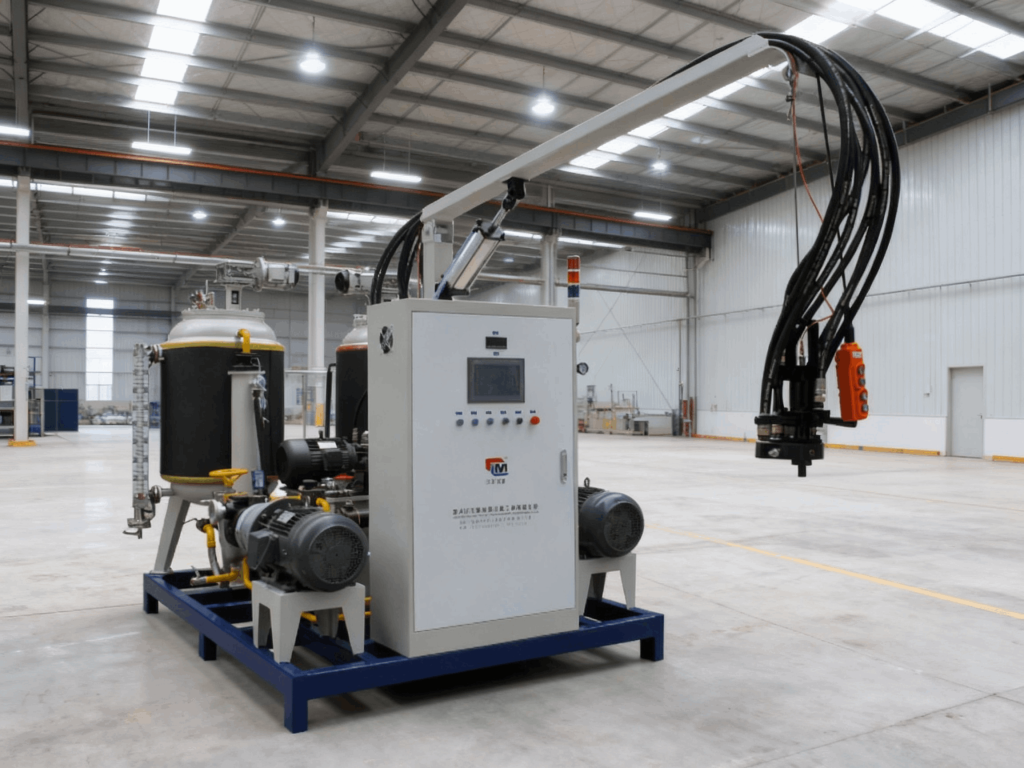
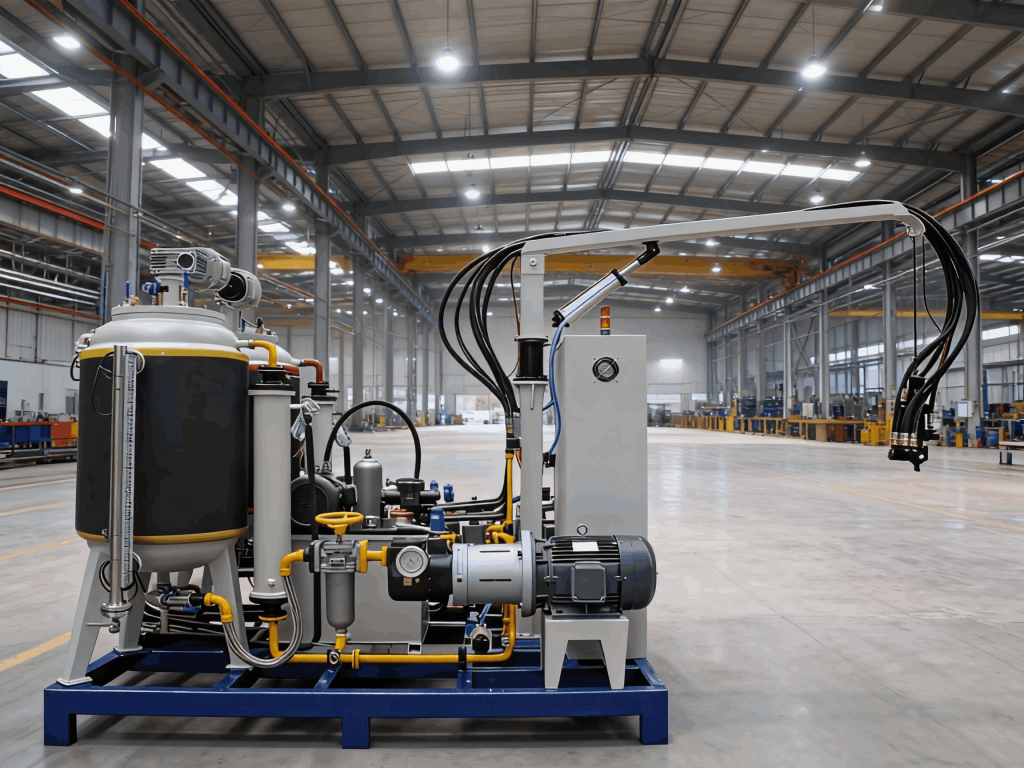
This set of equipment consists of two parts: casting machine and coating machine.
(II) Casting Machine (Precision Micro Flexible Foaming Machine: PU20F-WR)
1.Total Output Rate
At a running speed of 3 meters per minute, width of 1.25 meters, thickness of 4 millimeters and density of 250 kilograms per cubic meter, the required total output rate is 3.75 kilograms per minute. At a running speed of 3 meters per minute, width of 1.25 meters, thickness of 3 millimeters and density of 250 kilograms per cubic meter, the required total output rate is 2.81 kilograms per minute. Thus, the designed total output range of the casting machine is 1.5 to 4 kilograms per minute, which equals 25 to 66.6 grams per second. The mixing ratio A to B is set as 100 to 50 with stepless adjustment. The material temperature is kept between 22 and 25 degrees Celsius.
2.Main Configurations
(1) Tanks
① A-component Tank: 2 tanks of 160 liters each (diameter 500 millimeters × height 800 millimeters). Three-layer structure: acid-resistant stainless steel inner liner, heating or cooling jacket, outer thermal insulation layer made of rigid polyurethane foam. The cooling jacket with spiral baffles is equipped with paddle stirrers at a rotating speed of 80 revolutions per minute, driven by a 0.75 kilowatt 4-pole cycloidal reducer motor. The tank cover is fitted with feeding port, feeding pipe, vent port, sight lamp glass. The tank bottom is equipped with discharge port, return port, temperature sensing probe, cooling water inlet and outlet for the jacket. The paddle stirrer mixes fillers evenly up and down to prevent sedimentation. One A tank can be used for filler feeding and mixing, while the other serves as storage for A-component casting.
② B-component Tank: 1 tank of 160 liters (diameter 500 millimeters × height 800 millimeters). Three-layer structure: acid-resistant stainless steel inner liner, heating or cooling jacket, outer thermal insulation layer made of rigid polyurethane foam. It is equipped with frame stirrer at a rotating speed of 23 revolutions per minute, driven by a 0.75 kilowatt 4-pole cycloidal reducer motor. The tank cover is fitted with feeding port, feeding pipe, vent port, sight lamp glass. The tank bottom is equipped with discharge port, return port, temperature sensing probe, cooling water inlet and outlet for the jacket.
③ Cleaning Liquid Tank: 20 liters (diameter 273 millimeters × height 300 millimeters)
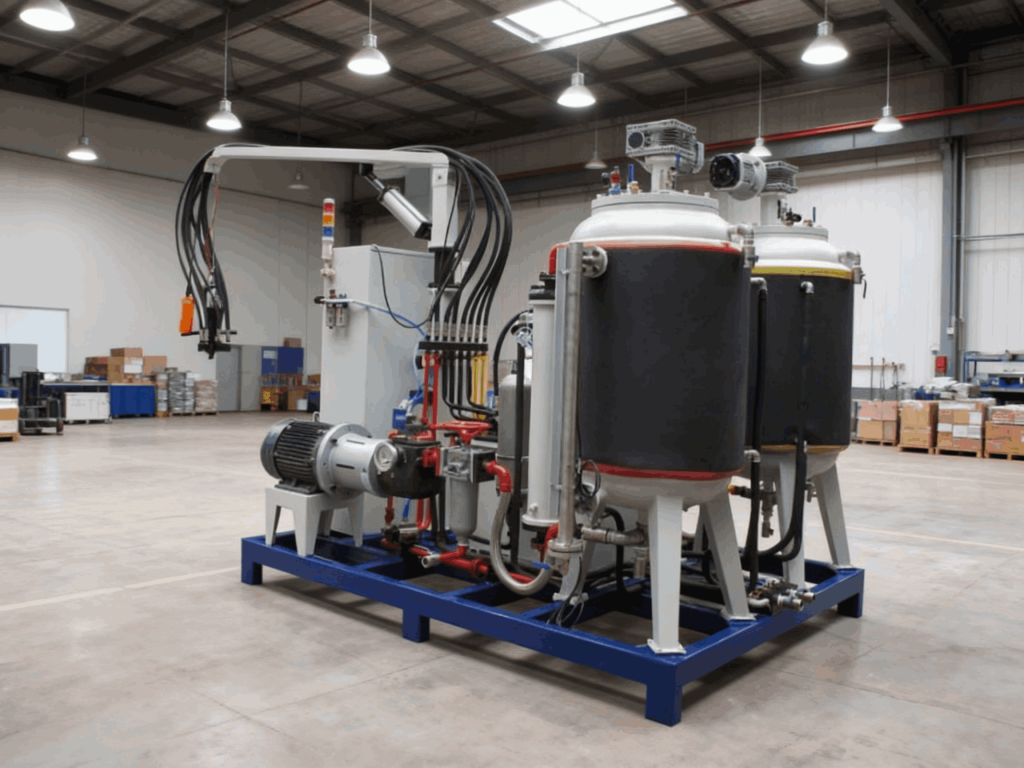
B Metering Pump: Low-speed high-precision metering pump Model GJ20 (20 cubic centimeters per revolution), driven by Model MBW-07-C stepless variable speed motor (0.55 kilowatt, 6 pole, speed range 26 to 130 revolutions per minute).
(3) Casting Head: Model 38-II, motor 1.5 kilowatt, 2 pole, multi-wedge belt drive, rotating speed 6025 revolutions per minute. Three-position cylinder rotary valve shaft switching, mixing head dimension diameter 38 millimeters × length 100 millimeters. Material pipes: A pipe M33 multiplied by 2, length 5 meters; B pipe M22 multiplied by 1.5, length 5 meters. Cantilever suspension installation.
(4) Electrical Components and Instruments Electrical parts: Export-type circuit breakers and AC contactors. 3 sets of intelligent digital temperature controllers with platinum resistance probes, for automatic monitoring and control of raw material temperature. 2 sets of digital pressure gauges (2 megapascals), to display outlet pressure of metering pumps and adjust casting pressure and return pressure. 2 sets of digital tachometers (0 to 999 revolutions per minute), to display pump rotating speed and flow rate so as to confirm casting output and mixing ratio. 1 set of HN60 programmable controller, for casting time adjustment (casting output) and automatic cleaning control.
三. Coating Machine (Three Common Schemes)
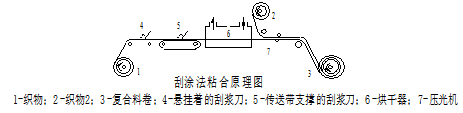
1.Adhesion by Doctor Blade Coating
The polyurethane mixture is directly applied onto the fabric surface through a slurry tank. A doctor blade controls coating thickness and uniform distribution. The coated layer is baked and pressed together by rollers.
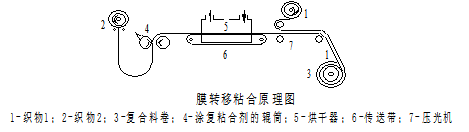
2.Film Transfer Bonding
The polyurethane mixture is evenly coated onto the non-stick conveyor belt or the surface of non-stick treated roller via the slurry tank and doctor blade to form a thin film. With the rotation of the conveyor belt or roller, this film is transferred onto the fabric.
The required bonding effect can be achieved after baking and lamination.
3.Indirect Coating
The reactive mixture discharged from the transversely reciprocating casting head is applied directly or through hoses onto a roller coated with release agent. A doctor blade spreads the mixture to a specified thickness. As the roller rotates, the non-flowing yet still liquid foaming mixture is immediately bonded to the carpet dried by an infrared heating unit. Further heating triggers foaming and curing of the foaming mixture. After cooling and trimming, the finished product is obtained.