Many owners of polyurethane product factories face the same dilemma when expanding production or launching new production lines: should they choose a low-pressure casting machine or a high-pressure foaming machine?
Some mistakenly believe high-pressure machines are always superior. After blind purchase, they find that high-pressure units are not suitable for high-viscosity elastomers, cannot handle fillers stably, and have limited flexibility for ratio adjustment. When used for producing wheels or rubber rolls, they suffer frequent breakdowns and high scrap rates. Some other factories adopt low-pressure machines for high-speed mass production of fast-reaction sealing foam parts, which results in low cycle efficiency and heavy consumption of cleaning solvents.
With more than 20 years of on-site commissioning experience, Wenzhou Feilong Polyurethane Equipment Engineering Co., Ltd. first explains the fundamental differences between these two types of machines, then introduces the selection logic for three typical products: polyurethane wheels, rubber rolls and sealing parts.
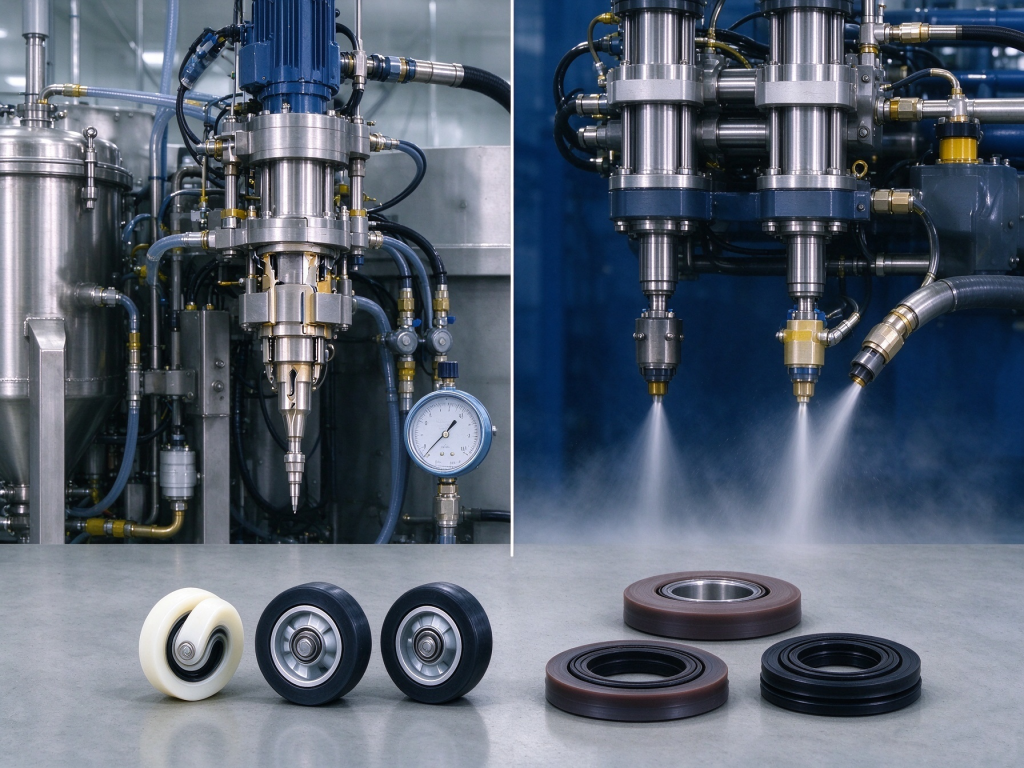
1. Core Differences Between Low-pressure Casting Machines and High-pressure Foaming Machines The most essential distinction lies in the mixing method, which directly determines raw material adaptability, cleaning requirements and operating cost. (1)Low-pressure Casting Machine (Elastomer Casting Machine) Mixing is achieved by mechanical shearing from stirring blades inside the mixing head, with system pressure generally between 0.3 MPa and 0.8 MPa. ✅ Advantages: Stepless adjustable mixing ratio, compatible with raw materials in a wide viscosity range; stably conveys liquid with inorganic fillers such as calcium carbonate and aluminum hydroxide; flexible formula switching, easy adjustment for different colors and hardness; lower equipment investment, no requirement for high-pressure resistant molds, so mold cost is reduced; suitable for intermittent casting and multi-variety small-batch orders. ⚠️ Limitations: The mixing head requires solvent cleaning after each casting cycle, which generates cleaning consumables; the casting cycle is relatively slow, not suitable for ultra-high-speed automatic cycles with dozens of shots per second. (2)High-pressure Foaming Machine High-pressure plunger pumps pressurize A and B components to 10–20 MPa. Two material streams collide at high speed inside the mixing chamber to complete mixing. Self-cleaning by piston movement, no solvent cleaning required. ✅ Advantages: Fast casting speed, ideal for large-volume continuous automatic production; no solvent consumption for cleaner production; fine and uniform cell structure for rigid and microcellular foam products. ⚠️ Limitations: Sensitive to raw material viscosity; high-viscosity elastomers and high-filler formulas tend to block nozzles; mixing ratio modification is cumbersome with high cost for formula change; high cost for the whole machine, hydraulic system and high-pressure molds, with high maintenance barriers; not suitable for formulas with large filler proportions.
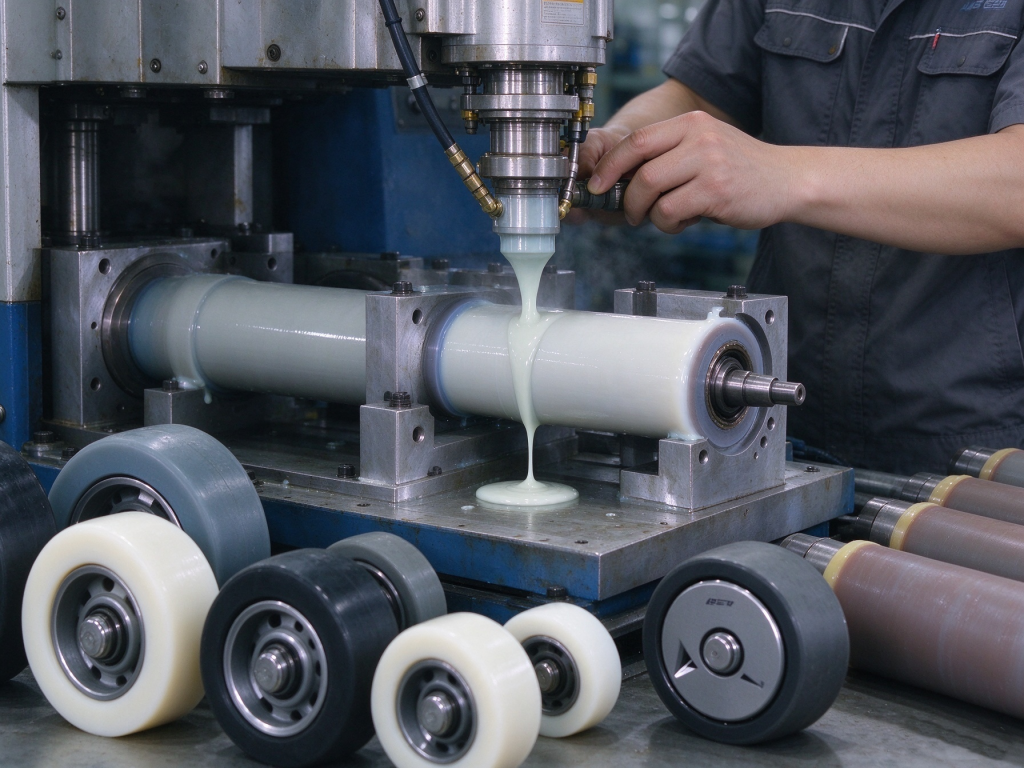
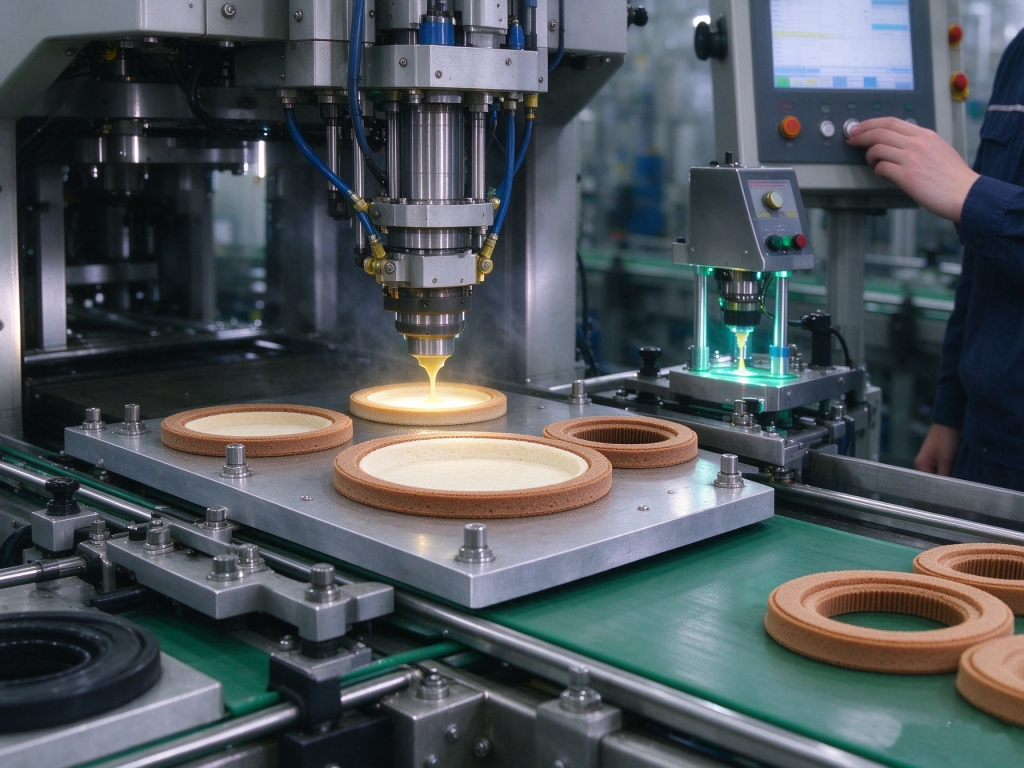
2. Selection Guide for Three Main Types of Production Lines (1). Polyurethane Wheels (forklift wheels, AGV wheels, caster wheels) Production Line PU wheels are high-density elastomer products with high raw material viscosity. Many formulas add fillers to cut cost. The hardness range is wide (Shore A60 ~ Shore D70), and specifications and hardness settings are frequently changed. 👉 Recommended solution: Low-pressure elastomer casting machine as the primary option Wheel production mostly adopts intermittent single-cavity casting with large single-shot volume and frequent fine-tuning of formulas. Low-pressure casting machines can run stably with fillers, offer wide adjustable ranges for mixing ratio and material temperature, and deliver thorough mixing to avoid internal bubbles, delamination and poor adhesion. High-pressure RIM equipment is only considered for ultra-large-batch production of a single standard wheel model. For most small and medium-sized manufacturers with diversified wheel specifications, low-pressure casting machines deliver better cost performance and stability. Matching auxiliary lines: rotary casting lines, mold ovens and post-curing stations, adaptable to both custom small batches and bulk orders. (2). PU Rubber Rolls (printing rolls, conveying rolls, coating rolls) Production Line Rubber rolls demand excellent surface finish, concentricity and uniform elasticity. They are usually cast in long cylindrical molds, mostly using polyester-based elastomers with high viscosity. Some formulas add fillers to improve wear resistance. 👉 Recommended solution: Low-pressure casting machine Rubber roll casting is a slow, self-leveling forming process requiring gentle material feeding and uniform mixing without impact-induced bubbles. The high-impact jet output of high-pressure machines easily causes internal bubbles and pinholes, leading to high rejection rates. Low-pressure casting machines support controllable flow rate, paired with long feed pipes and traversable casting heads to distribute material evenly along the axial direction of the mold, perfectly matching self-leveling forming for rubber rolls. Factories often produce rubber rolls of different diameters and hardness grades, where low-pressure machines show great advantages in flexible formula switching. (3). Filter Seals, Seal Pads and Foam Seal Ring Production Line There are two technical routes for seal parts with different selection requirements: Route A:Rigid microcellular foam seal pads and standardized mass air filter seals: High-pressure foaming machine These products feature fast reaction speed, small single-shot weight and high cycle requirements, with limited product varieties. High-pressure machines support high-speed injection and self-cleaning, ideal for fully automatic assembly lines with large output and low consumable cost. Route B:Multi-specification, small-batch elastomer sealing blocks and special-shaped seals: Low-pressure precision casting machine Frequent model changes and formula adjustments are common, and some formulas contain fillers. Low-pressure casting machines feature a wide adjustable flow range and stable metering at low flow rates, enabling convenient commissioning for new items. They are suitable for flexible production and sample development in filter manufacturers, such as our PU20F-WR micro precision foaming model.
3. Four Questions to Confirm Before Equipment Selection (1)Is your product a solid elastomer part or microcellular foam part? Solid wear-resistant parts usually suit low-pressure machines; standardized foam parts suit high-pressure machines. (2)Do you need to add fillers in the formula? If calcium carbonate, aluminum hydroxide or similar fillers are used regularly, low-pressure casting machines are preferred. (3)How many product variants do you produce, and how often do you change formulas? Low-pressure machines are more worry-free for frequent product switching. (4)What is your annual production volume? Only evaluate high-pressure automatic solutions when annual output reaches hundreds of thousands of pieces for a single product. (5)Many factories make mistakes by blindly chasing “high-pressure” technology while ignoring their own formula and production mode. There is no universally superior machine, only equipment that matches your products. 4. Supporting Services from Feilong Wenzhou Feilong Polyurethane Equipment provides customized low-pressure elastomer casting machines, precision micro foaming machines, rotary production lines and filter seal casting lines. According to your products including wheels, rubber rolls and seals, we can calculate discharge rate and mixing ratio range, and provide trial casting, formula guidance and plant layout solutions. During on-site commissioning, our engineers help resolve common process defects such as bubbles, unstable hardness and filler sedimentation. We deliver both equipment and mature process support. Closing Equipment selection should not be judged by operating pressure, but by your products, formulas and production mode. If you are planning production lines for wheels, rubber rolls or sealing parts, send us your samples, capacity targets and formula requirements. We will match the most suitable equipment solution for you.
 FEILONG PU MACHINE