Search the whole station
Wenzhou Feilong Polyurethane Equipment Engineering Co., Ltd.
Chinese website: http://www.pumcn.com/
English website: https://www.flpumachine.com/
The mixing head is the core component of polyurethane casting machines, where A and B components meet, shear and blend before pouring into molds. Many elastomer workshops suffer recurring clogging. Cleaning cured residues requires disassembly, soaking and scraping, which consumes plenty of time and spare parts, interrupting continuous production of wheels, rollers and sealing parts.
When blockage occurs, operators often extend flushing duration and add more cleaning solvent. This only works temporarily. Repeated clogging is rarely caused by insufficient cleaning alone. It is usually a combined problem of seal leakage, improper recirculation, unstable temperature, contaminated raw materials and non-standard shutdown procedures. Below we analyze causes, equipment adjustments, process optimization and daily inspection items.
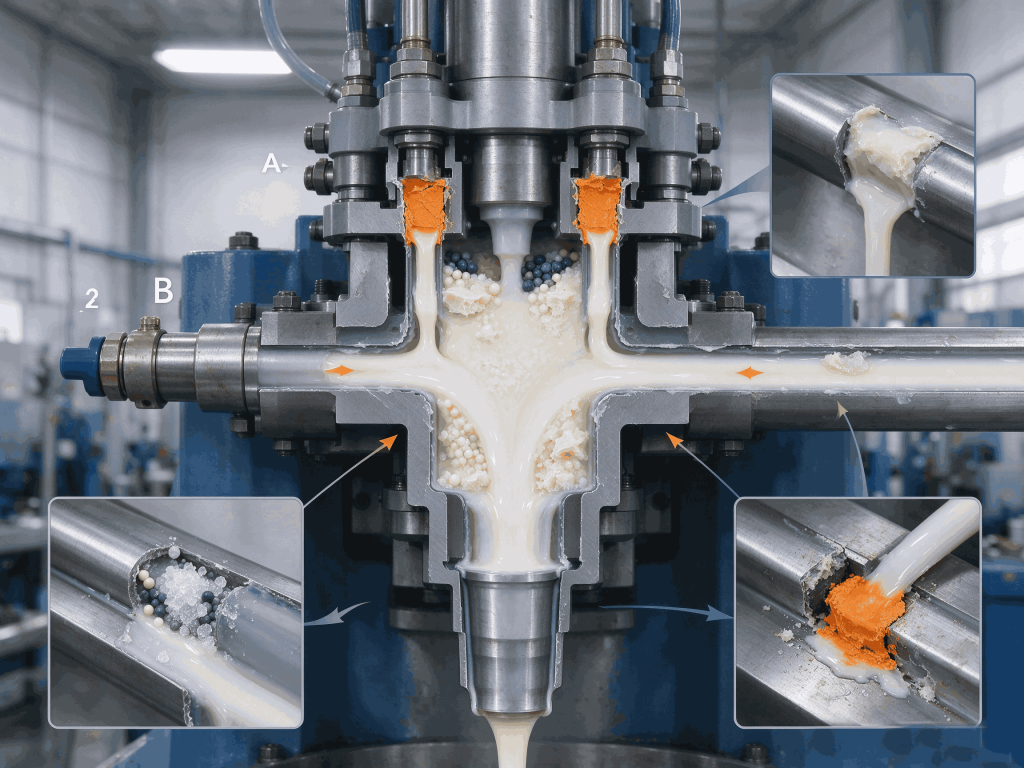
1. Main Causes of Recurring Mixing Head Clogging
1.1 Worn seals and cross-leakage (most frequent reason)
Worn shaft seals and face seals inside the mixing head allow slow cross-contamination between A and B streams during recirculation and standby. Materials react inside the mixing chamber and build up hardened deposits, narrowing flow channels gradually until complete blockage. This type of clog develops slowly, marked by falling output and rising pressure before full blockage.
1.2 Excessive moisture in raw materials and isocyanate crystallization
Moisture reacts with isocyanate and forms insoluble polyurea solids. Isocyanate tends to crystallize at low temperature, forming granular deposits trapped inside gaps. For calcium carbonate or aluminum hydroxide filled formulations, solid filler particles accumulate at dead zones and accelerate clogging.
1.3 Poor temperature control changes reaction speed
Overheated feed accelerates gelation inside the mixing cavity before discharge. Too low temperature increases viscosity; residual material sticks to inner walls and cannot be flushed away easily.
1.4 Defective cleaning circuit design
Insufficient solvent flow, unstable purge air pressure, dead zones that cleaning fluid cannot reach. Manual cleaning without fixed timing and flow control is inconsistent and unreliable.
1.5 Non-standard shutdown routine
Operators skip cleaning during mold change, batch switch or short breaks. Material stays trapped inside the mixing head and reacts when recirculation stops.
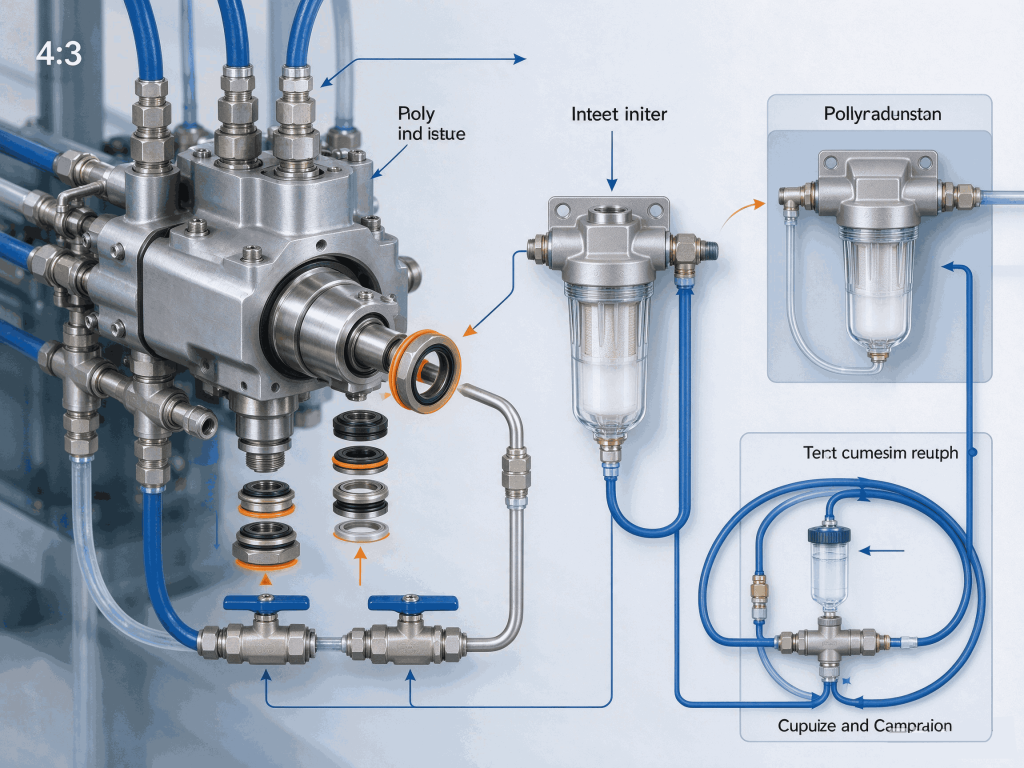
2. Equipment Adjustments
2.1 Inspect and upgrade sealing system to stop cross-leakage
Regularly disassemble and inspect seals, O-rings and face seals and replace them on schedule. Select solvent-resistant, PU-compatible sealing materials. For recurring cross-leakage, upgrade to patented anti-backflow sealing structure to prevent intermixing of A and B components during standby.
2.2 Stabilize temperature and pre-process raw materials
Maintain stable temperature for tanks and transfer pipelines to avoid isocyanate crystallization. Apply nitrogen blanketing and dry air filtration to control moisture. Install inlet filters for filled formulas to trap large filler particles.
2.3 Optimize solvent and air purge circuits
Add pressure regulators and filters on solvent lines for stable flow. Equip compressed air lines with oil-water separators. Combine solvent flushing and air blast to eliminate dead zones.
2.4 Configure automatic cleaning logic in PLC
Set automatic short flush during pouring intervals and full cleaning cycle for long shutdowns. Multi-component models support independent channel flushing to avoid caking of color paste and additives.
2.5 Select suitable mixing head structure
For fast-cure and highly-filled formulations, adopt detachable blade-type mixing heads with simple flow paths and minimal dead space for easier maintenance. Dynamic mixing heads are generally easier to clean than static mixers.
3. Production Process & Management Optimization
3.1 Tiered cleaning rules for different downtime lengths
Short stop (within 15 min, mold change): Keep recirculation running and simple air purge;
Medium stop (15–60 min): Short solvent flush + air purge;
End of shift or long idle: Full cleaning; soak disassembled parts if heavy residue exists. Do not apply identical cleaning routine for all scenarios. Over-flushing wastes solvent, while under-flushing leads to clogging.
3.2 Raw material control
Seal raw material drums tightly and dehumidify workshop. Keep isocyanate tanks under nitrogen protection. Pre-disperse filled materials and replace filters when pressure differential rises.
3.3 Inspection log
Record mixing pressure, purge air pressure and seal leakage every shift. Track clogging time, formula type and downtime to schedule preventive maintenance instead of emergency repair.
3.4 Operator training
Standardize cleaning sequence, solvent dosage and air pressure for all operators to reduce human inconsistency.
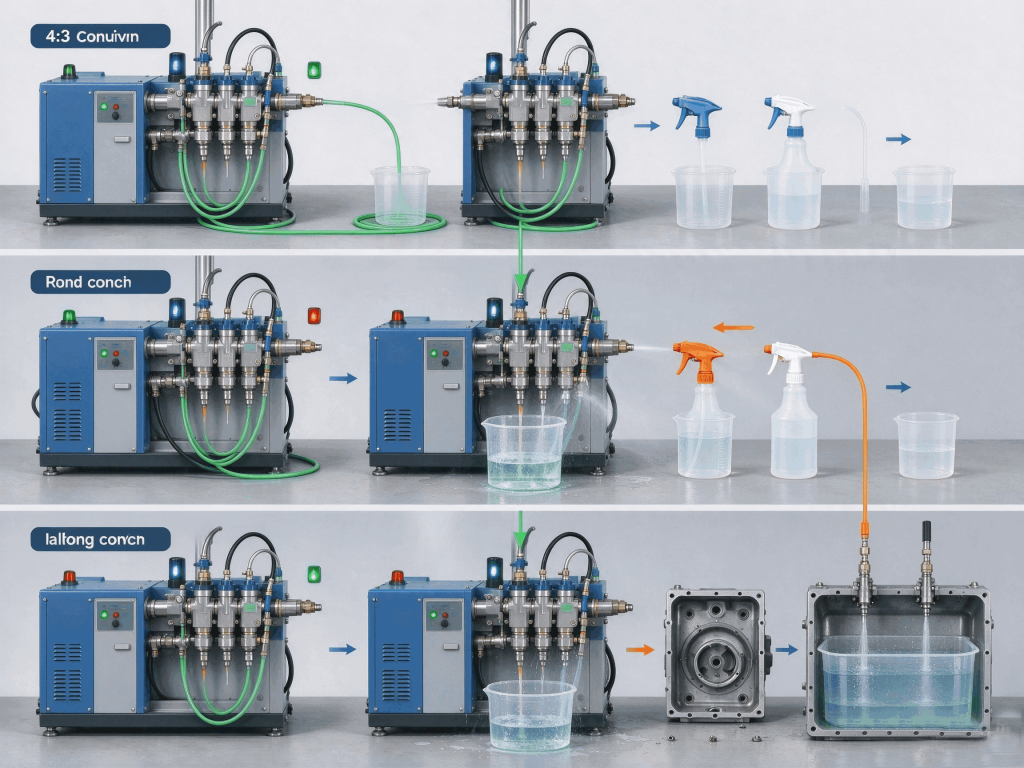
4. Emergency Handling & Common Pitfalls
When blockage happens, soak and dissolve cured material gently. Never pry or strike the mixing cavity hard, which scratches sealing surfaces and makes cross-leakage worse afterwards.
⚠️ Common mistake: Only add more solvent and extend cleaning time without checking seals, upstream filters or raw material moisture. This brings only temporary relief.
Conclusion
Mixing head clogging and difficult cleaning are problems that rely more on prevention than remediation. Reliable sealing, stable temperature control, well-designed cleaning circuit and standardized shutdown workflow reduce downtime, solvent consumption and extend mixing head service life.
Wenzhou Feilong Polyurethane Equipment Engineering Co., Ltd. supplies casting machines equipped with self-developed anti-leakage mixing heads and automatic solvent-and-air cleaning systems. Custom cleaning schemes are available for fast-cure and high-filler formulations to minimize mixing head blockage and support stable continuous production.
 FEILONG PU MACHINE