Keywords: TPU, twin-screw continuous process, conveyor-bed continuous process.Thermoplastic polyurethane elastomer (TPU) is a linear block copolymer composed of soft segments of oligomeric polyol and hard segments of diisocyanate-chain extender. Similar to other thermoplastics, it features rubber elasticity and plastic properties at room temperature, and melts into viscous fluid at high temperature. It can be processed by injection molding machines (such as extrusion, injection, calendering, blow molding, compression molding, etc.) without post-treatment processes such as mixing and vulcanization, which saves energy and allows recycled reuse of products. TPU is a thermoplastic-processable and solvent-soluble polyurethane elastomer. Compared with MPU (mix-millable polyurethane elastomer) and CPU (cast polyurethane elastomer), it has basically linear molecules with few or no chemical cross-links, and only certain physical cross-links. It delivers high modulus, high strength, high elongation and high elasticity, as well as excellent wear resistance, oil resistance, low-temperature resistance and aging resistance. It can be manufactured into various products via general plastic processing methods, and its scraps are recyclable. A variety of auxiliaries and fillers can be incorporated to modify certain physical properties, processing performance or reduce costs.
1 Classification **1.1 Classification by structural characteristics** (1) Fully thermoplastic type: there are no chemical cross-linkages between molecules, only hydrogen-bond-dominated physical cross-links. It can be dissolved in solvents such as DMF, with isocyanate index (NCO/OH) r0≤1. (2) Semi-thermoplastic type: molecules contain a small amount of chemical cross-linkages of allophanate. It is a polymer with both thermoplastic and thermosetting properties. Due to residual minor isocyanate groups in particles, moisture contact must be avoided during storage. Post-heating maturation is required to complete cross-linking after product forming. Its recycling is difficult (chemical bonds fracture above 150 ℃ for reprocessing). Nevertheless, minor chemical cross-links improve compression set and chemical resistance of finished articles. **1.2 Classification by raw-material sources** (1) Polyester type: superior heat resistance and mechanical performance compared with polyether type. (2) Polyether type: manufactured from PPG or PTMG. PPG-based TPU has inferior physical properties and limited practical applications; PTMG-based TPU commands higher price and is only adopted for special-purpose scenarios. 2 Raw Materials and Formulations **2.1 Raw Materials** **2.1.1 Polyols** 1) Polyester polyol (PES): Poly(ethylene adipate), Mn 2000, hydroxyl value 55±3 mgKOH/g (PEA-2000); Poly(ethylene-butylene adipate), Mn 2000, hydroxyl value 56±3 mgKOH/g (PEB-2000). 2) Polyether polyol (PET): ① Polyoxypropylene glycol (PPG), Mn 2000, hydroxyl value 56±3 mgKOH/g; ② Polytetrahydrofuran glycol (PTMG), Mn 2000, hydroxyl value 56±3 mgKOH/g. **2.1.2 Diisocyanate**: MDI is commonly adopted (low cost, ample supply, favorable comprehensive tech-economic benefits). Its cyclic, compact and symmetric molecular structure reinforces physical properties of TPU. Pure MDI (aromatic): white or pale-yellow solid at ambient temperature, emits pungent odor upon heating. Melting point ≥38 ℃, boiling point 194-199 ℃/5mmHg, density 1.19. Molecular formula & molecular weight: C15H10N2O2; 250. **2.1.3 Chain extender (low-molecular-weight diol)**: 1,4-butanediol (BDO) (aliphatic open-chain diol). Colorless oily liquid, highly hygroscopic. Relative molecular mass M=90.1, density 1.02, boiling point 229.5 ℃, melting point 20.1 ℃. **2.2 Formulation**: PES (MW 2000, difunctional) 1 mol; MDI 3 mol; BDO 2 mol; isocyanate index R=(NCO/OH)=0.97~1.03. Performance: density 1.2; hardness (Shore A) 70-95; tensile strength 35-40 MPa; 300% modulus 3-18 MPa; elongation 450-700%; abrasion (mass loss) 0.0025~0.15; brittle temperature -17~-30 ℃.
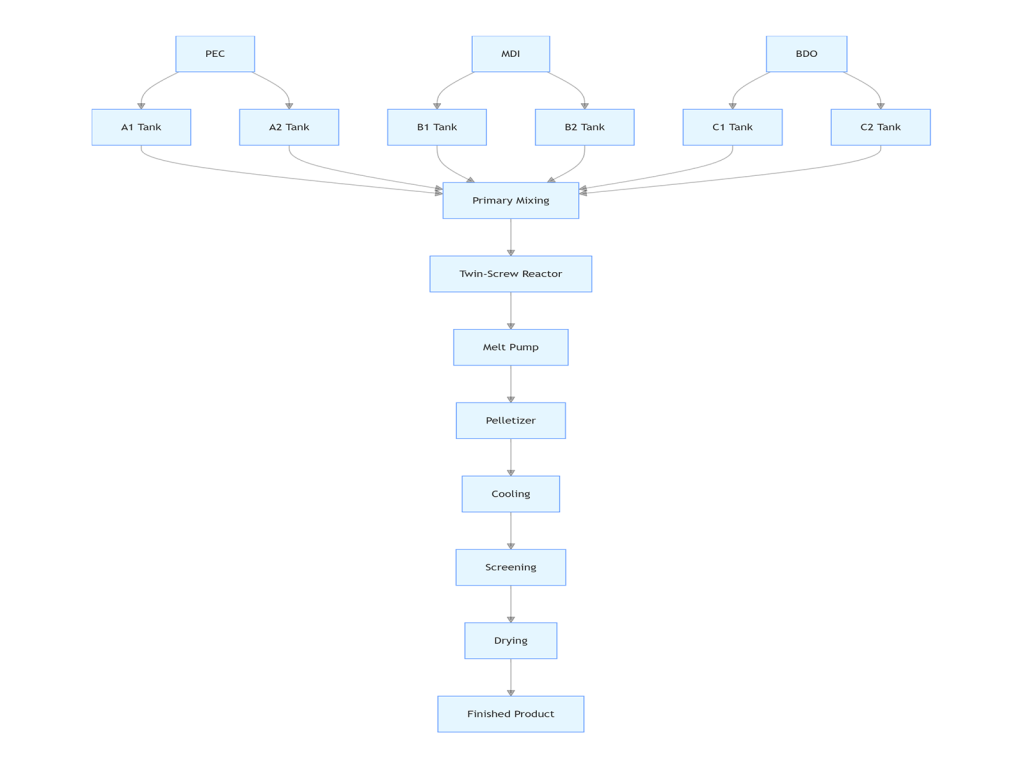
3 Production Methods **3.1 One-shot process**: Prescribed raw materials including polyester, MDI and BDO are proportionally mixed inside designated equipment to produce TPU. For two-component system: MDI serves as one component; polyester mixed with BDO forms the other component. **3.2 Prepolymer process**: Polyester first reacts with MDI to form prepolymer, followed by chain extension with BDO to yield TPU. Theoretically it achieves uniform distribution of hard and soft segments for superior TPU physical properties; yet industrial practice encounters multiple drawbacks: 1) Highly reactive MDI causes severe material adhesion onto reactor walls, bringing difficulty in cleaning, lowering heat-transfer efficiency and prolonging operation cycles; 2) Long production cycle leads to low productivity; suitable only for laboratory rather than mass industrial manufacture; 3) High energy consumption raises production costs; 4) Side-reactions induced by wall-adhered MDI prepolymer upset the stoichiometric ratio of -NCO to -OH, degrading final TPU performance. **3.3 Conclusion**: As stated above, the one-shot process is preferred for current industrial production of TPU masterbatch. 4 Production Processes **4.1 Twin-Screw Continuous Process** **4.1.1 Production Technology**: Molten high-molecular-weight polyester diol (PES) is fed into tank A, heated to target temperature (100-120 ℃), vacuum-dehydrated under low-speed stirring for 2-3 h until moisture content <0.05%. Vacuum is released and nitrogen purging is implemented for standby. Molten MDI is fed into tank B, heated to target temperature (60-70 ℃), vacuum-degassed under low-speed stirring for 0.5-1 h. Vacuum is released and nitrogen purging is implemented for standby. Low-molecular-weight diol BDO is fed into tank C, heated to 30-50 ℃, vacuum-dehydrated under low-speed stirring for 0.5-1 h to meet moisture requirement. Vacuum is released and nitrogen purging is implemented for standby. Two identical sets of storage tanks are configured for each component for continuous feeding to metering pumps: one tank executes vacuum dehydration while the other supplies feedstock. Raw-material streams are precisely metered by metering pumps per formulation ratio and delivered to casting head for primary homogeneous mixing under high-speed agitation. Mixture then flows into twin-screw reactive extruder for further homogenization and chemical reaction, followed by pelletizing and screening. **4.1.3 Process block diagram**:
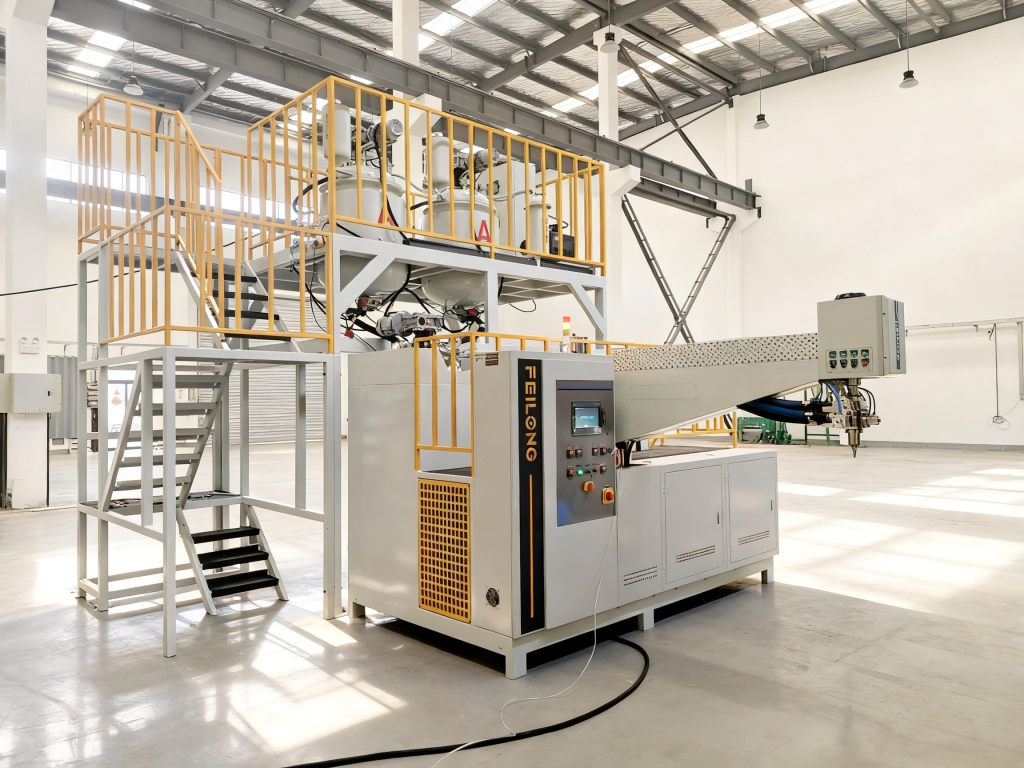
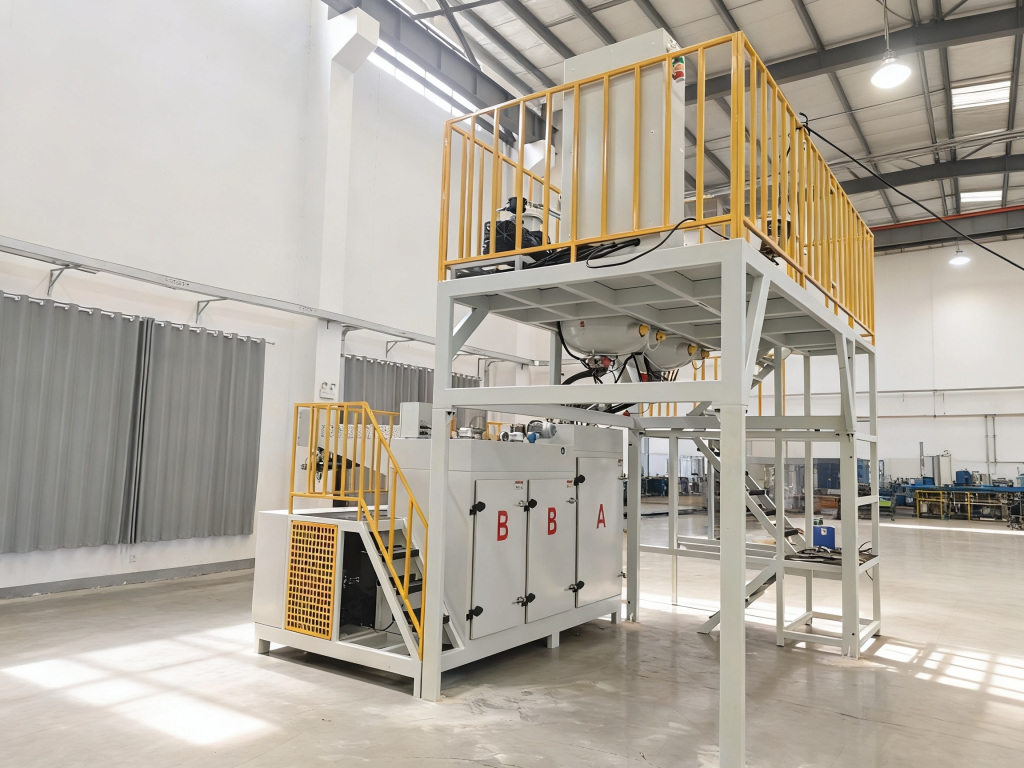
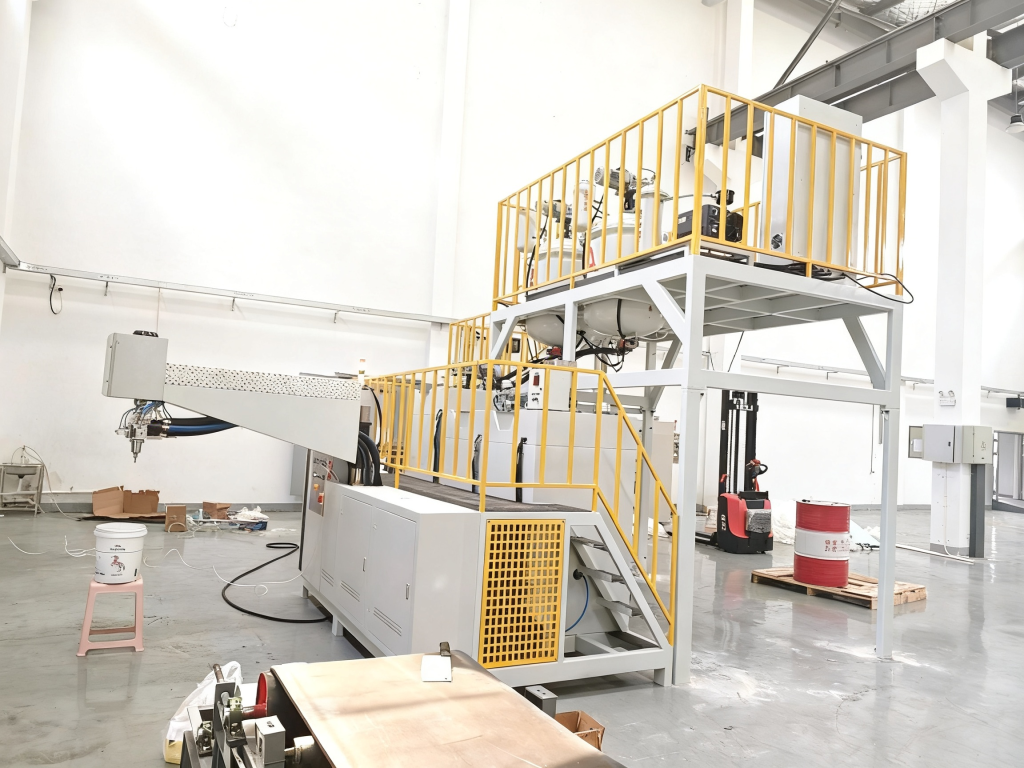
**4.1.4 Brief introduction of main equipment** **4.1.4.1 TPU casting machine (Model TPU30F-Ⅲ)**: Main technical parameters: ① Total casting output: 1-5 kg/min (16.6-83.3 g/s). Designed mixing ratio A:B:C=100:(20~70):30; metering error ≤±0.5%. ② Operating temperature: Component A: 80-90 ℃; Component B: 50-60 ℃; Component C: 30-50 ℃; casting-head 70-80 ℃. ③ Temperature deviation: ±2 ℃; vacuum degree 5-10 mmHg. (2) Raw-material processing equipment: ① Tank for component A (PES): 2×140L (φ500×600). Three-layer construction: stainless-steel inner liner, heat-conducting-oil heating jacket, outer rigid-PU foam thermal-insulation layer. Equipped with frame-type stirrer (30 r/min, 0.55 kW) and precision shaft seal for airtightness. Fitted with feeding port, sight glass, vacuum & nitrogen inlet, low-level alarm. Heating power 2×4.5 kW. ② Tank for component B (MDI): 2×120L (φ500×500), same three-layer construction, frame-type stirrer (60 r/min, 0.55 kW), heating power 2×4.5 kW. ③ Tank for component C (BDO): 2×80L (φ400×500), frame-type stirrer (60 r/min, 0.55 kW), heating power (1+2) kW. (3) Vacuum system: Vacuum buffer tank 80L (φ400×500), stainless-steel multi-baffle design. Vacuum pump: Model 2X-15A (2.2 kW). (4) Heating system (three independent sets for A/B/C streams): Heat-conducting-oil tank 70L, heating power 4.5 kW. Circulating oil pump: Model B-BB16 gear pump, 0.75 kW 6-pole.
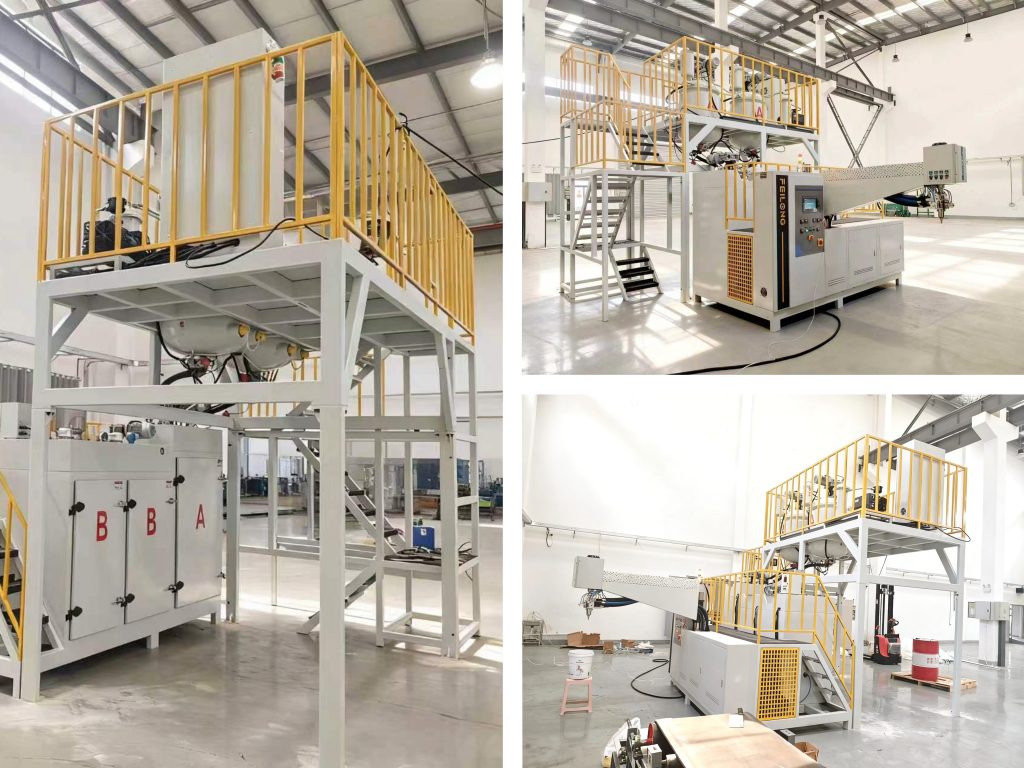
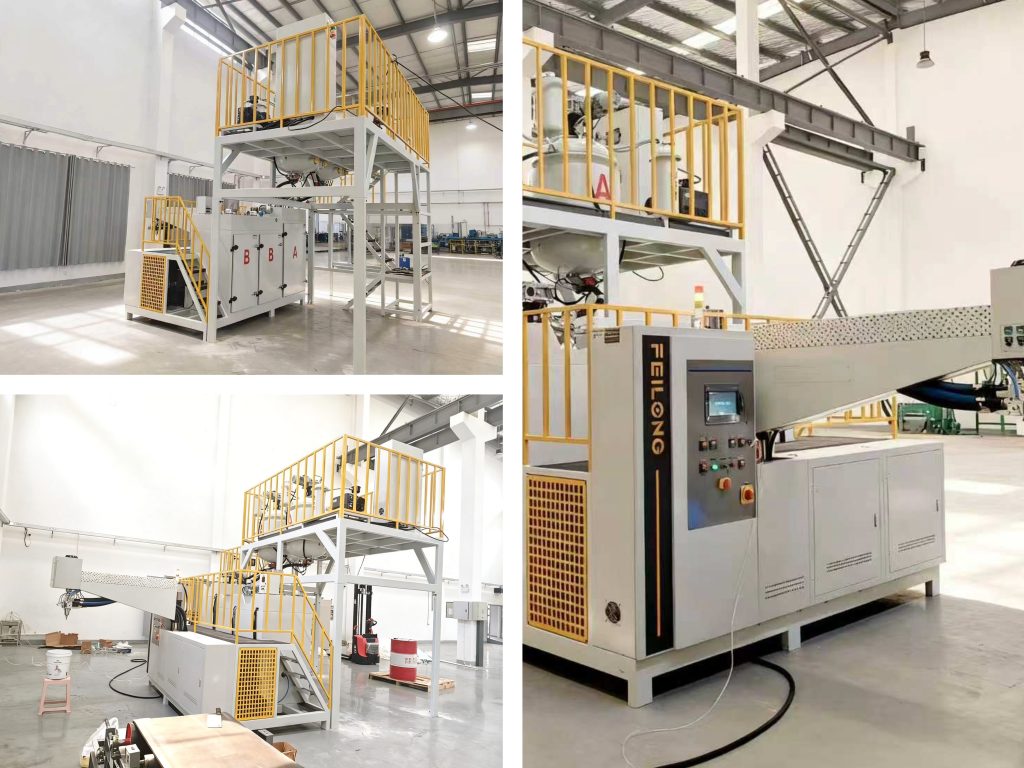
**4.1.4.2 TPU casting machine (Model TPU30F-Ⅲ)**. (5) Metering pumps: high-precision low-speed metering pumps (pressure-withstanding 10 MPa, temperature-resistant 450 ℃), driven by high-precision gear-reduction motors with imported frequency converters. Each stream is equipped with imported digital flow-meter for closed-loop automatic control over metering pumps. Pump A GJ20, speed 30-200 r/min, power 0.75 kW 4-pole; Pump B GJ12, speed 30-200 r/min, 0.75 kW 4-pole; Pump C GJ9, speed 30-200 r/min, 0.75 kW 4-pole. (6) Casting head: three-component high-temperature casting-head delivering homogeneous mixing and bubble-free output. Agitator motor 1.5 kW 2-pole, rotational speed 3000-8000 r/min (variable-frequency adjustable). (7) Control & electrical system: digital intelligent temperature controllers ensure reliable and precise heating for filters, metering pumps and casting head. Pressure, rotational-speed (ratio) and other parameters are monitored by full-digital high-precision instruments. Imported electrical components are adopted.
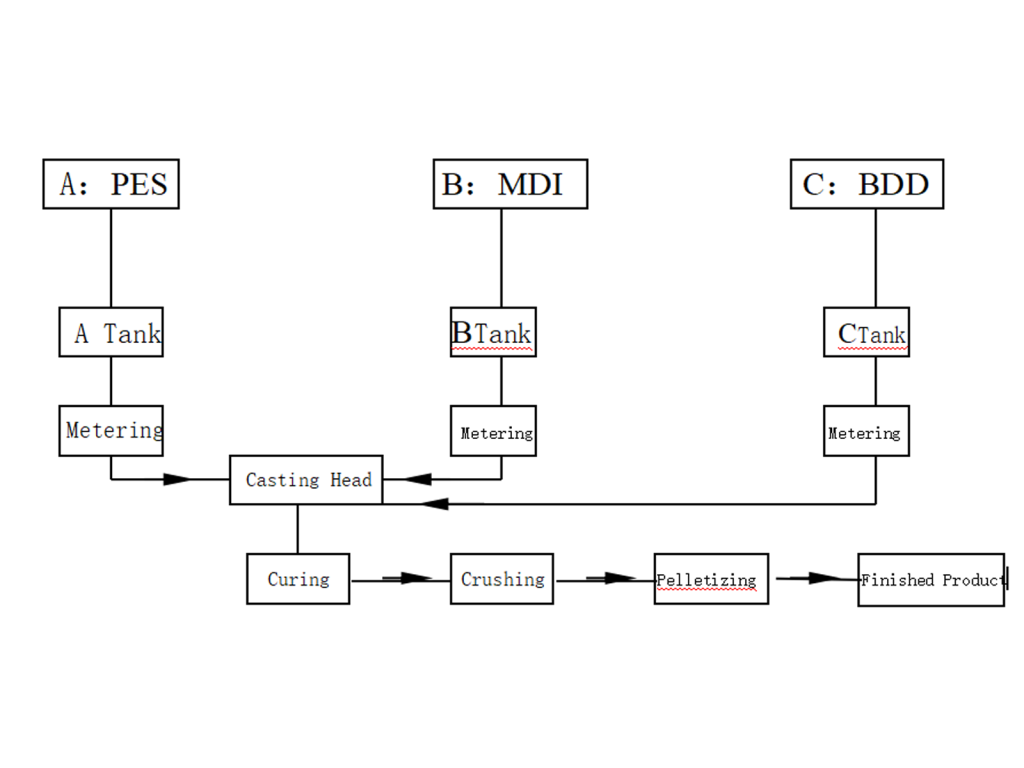
**4.1.4.3 Twin-screw reactive extruder (for user reference during equipment selection)**: Model LSF-68 (nine-zone temperature-controlled barrel, standard JB/T5420-91). Nominal screw diameter φ68 mm, center distance 60 mm, screw L/D ratio 48, clearance between screw and barrel ≤0.02 mm. Maximum screw rotational speed 260 r/min (screw speed shall guarantee material residence time inside barrel of 1-2 min). Main motor power 40 kW, maximum throughput 200 kg/h. For co-rotating twin-screw extruder, screws move in opposite directions inside intermeshing zone: one screw drags material into gap while the other extrudes material out. Material advances in ∞-shaped flow path. Velocity variation and large relative velocity inside meshing zone greatly promote mixing and homogenization. Small intermeshing clearance plus opposite thread-groove velocity delivers high shear rate and self-cleaning performance that strips any material deposits adhered onto screw surfaces. 4.2 Conveyor-Bed Continuous Process **4.2.1 Production Technology**: High-molecular-weight polyester diol (PES) and low-molecular-weight diol (BDO) are charged into tank A and tank C respectively, vacuum-dehydrated under stirring for 0.5-1 h until moisture <0.05%. Vacuum is released and nitrogen purging is done for standby (tank A 80-90 ℃, tank B 50-60 ℃). Refrigerated MDI is heated under vacuum at 60 ℃ for 1 h to remove condensed moisture. Streams are proportionally metered by metering pumps to casting-head, thoroughly mixed under high-speed stirring without bubble formation, then poured onto maturator. After maturation, material is crushed and pelletized to obtain finished product.
**4.2.2 Process block diagram**:
5 Examples of Domestic TPU Grades **5.1 Polyether-based thermoplastic polyurethane elastomer (TPU) (PTEG-MDI-BDO)** **5.1.1 Characteristics**: Thermoplastic upon heating, processable on conventional plastic-processing machinery. Features excellent hydrolysis resistance, low-temperature performance, weather resistance, ozone resistance and electrical insulation. Maximum service temperature 80 ℃ under dry conditions.
**5.1.2 Production method**: Adopt copolymerization process. Polymerize polytetrahydrofuran glycol (PTEG) with chain extender 1,4-butanediol (BDO) and diisocyanate MDI. **5.1.3 Application fields**: Mainly used for insulation and sheath layers of various wires & cables, high-pressure oil tubes and water hoses, various gaskets, rings and sheets, blow-molded films, sports-shoe soles & uppers, mechanical sealing parts, filter screens; also used for formulating coatings and adhesives.
**5.1.4 Specifications (enterprise standard)**
**5.1.5 Manufacturers examples**: Shanxi Research Institute of Chemical Industry, Tianjin Chemical-Plant for Plastics, Shandong Lunan Chemical Plant, Tianjin Polyurethane Products Factory, etc. **5.2 Polyester-based thermoplastic polyurethane elastomer (TPU) (PES-MDI-BDO)** **5.2.1 Characteristics**: Thermoplastic upon heating, processable on plastic-processing equipment. High mechanical strength; outstanding wear resistance, oil resistance, dry-aging resistance and low-temperature & electrical-insulation performance. Poor hydrolysis resistance, susceptible to hydrolysis under hot-water or humid-hot conditions. **5.2.2 Production method**: Adopt copolymerization process. Adipic acid reacts with ethylene glycol / butanediol to synthesize polyester diol, which further copolymerizes with MDI in presence of chain-extender. **5.2.3 Application fields**: Applied for pressure-resistant rubber hoses, air ducts, food-grade conveyor belts, hot-melt films, anti-slip stair mats, wire-cable sheaths, pipe coatings, round belts, V-belts, shoe soles & uppers, anti-slip chains, mining sieve plates, food powder sieves, various gears, lawn-mower sealing rings and dust-proof gaskets.
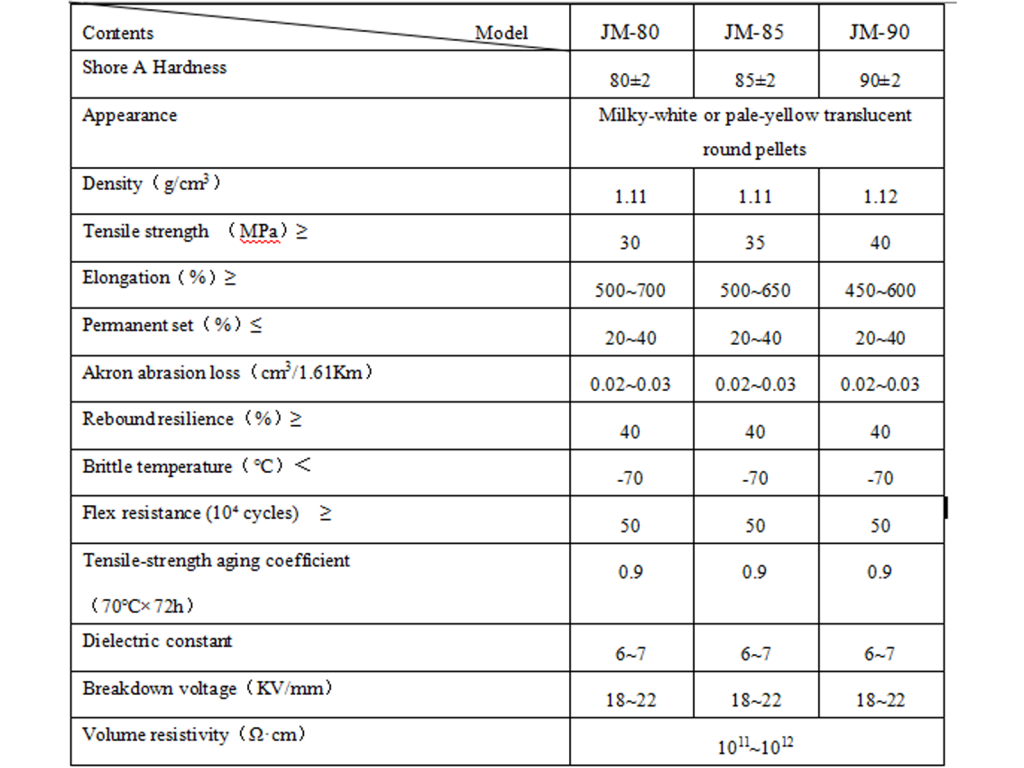
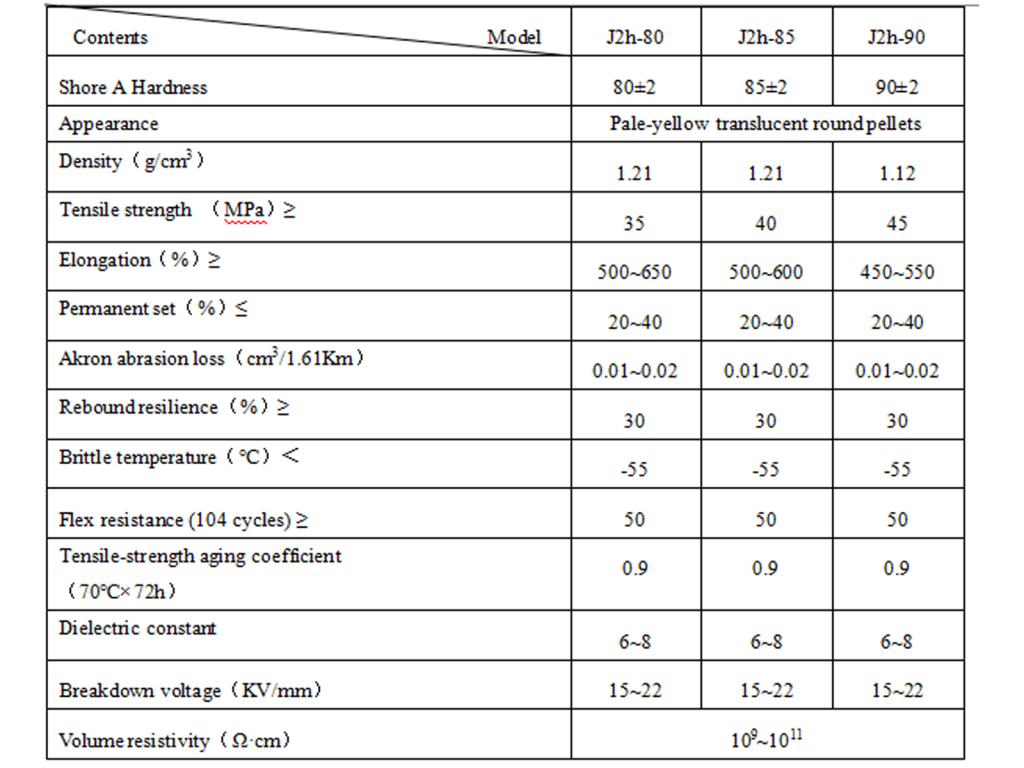
5.2.4 Specifications (enterprise standard)
**5.2.5 Manufacturers examples**: Tianjin Polyurethane Products Factory, Sanmen Polyurethane Products Factory (Zhejiang), Shanxi Research Institute of Chemical Industry, Shenyang Polyurethane Products Factory, Jinan Xinghua Polyurethane Products Factory, etc. **Acknowledgements**: Grateful acknowledgement is extended to Mr. Jia Lincai, Ms. Zhao Yuhua and Mr. Liu Liangbing for their earnest reviewing and valuable suggestions for this manuscript.
 FEILONG PU MACHINE