Search the whole station
Wenzhou Feilong Polyurethane Equipment Engineering Co., Ltd.
Chinese website: http://www.pumcn.com/
English website: https://www.flpumachine.com/
Many owners and technical supervisors of polyurethane product factories make the same mistake when purchasing casting machines. They only compare quotations and appearance, without carefully checking the core parameters of the equipment. After delivery, they find that the flow rate does not match the production requirement, the mixing ratio is unstable, the pump gets clogged easily when filled with fillers, or the temperature control fails to meet the formula requirements. The machine ends up sitting idle in the workshop and cannot run normally, putting buyers in a difficult position.
With more than 20 years of experience in equipment manufacturing and on-site commissioning, Wenzhou Feilong Polyurethane Equipment Engineering Co., Ltd. has sorted out the key parameters that must be confirmed before procurement for your reference during equipment selection.
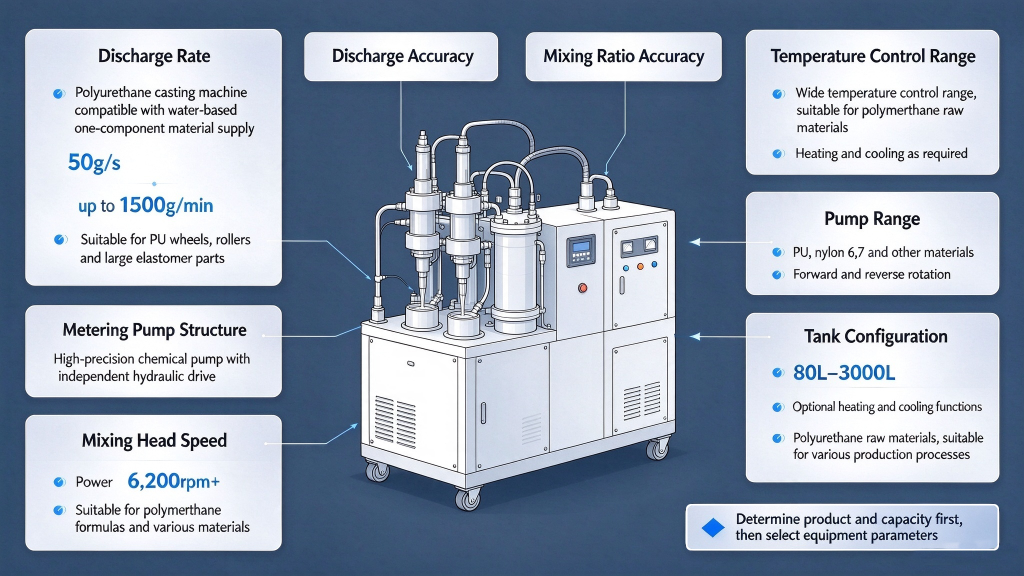
1. Discharge Rate (Casting Flow Range): Focus on the adjustable range, not only the maximum value
Discharge rate, usually measured in kilograms per minute or grams per second, is one of the first parameters customers ask about. A common pitfall is only paying attention to the maximum flow marked on the nameplate.
For example, if the machine is marked with a maximum output of 4 kilograms per minute, it does not guarantee stable metering at a low flow of 1 kilogram per minute. If your workshop produces both large parts such as rollers and wheels and small sealing blocks, you need to confirm the adjustable range from the minimum to maximum flow.
Continuous production lines (carpet backing, coil coating): Calculate the required output per minute according to line speed, thickness and density, and reserve 10 to 20 percent margin. Do not run the machine at full load for a long time.
Intermittent casting (wheels, pads, nylon parts): Calculate based on single casting weight and allowable casting time.
If a small-flow machine runs continuously at its maximum capacity, mixing ratio drift, heat generation and wear of sealing parts will accelerate significantly.
Practical tip: Provide the equipment supplier with samples, product density, single casting weight and planned production capacity. Let them calculate the required flow instead of submitting a random figure.
2. Mixing Ratio Accuracy and Adjustable Range, the foundation of stable product quality
The mixing ratio of A and B components directly determines the hardness, strength, curing speed and hydrolysis resistance of finished polyurethane products. It is also a major cause of bubbles, delamination, poor adhesion and brittleness.
Two points need to be checked during selection:
Whether the mixing ratio adopts stepless adjustment or fixed gear adjustment. Elastomer, MC nylon and foam formulas often require fine tuning, so fixed-ratio machines have poor adaptability.
Confirm the long-term continuous metering repeat accuracy, not only static idle accuracy. Some new machines show accurate ratios at the initial commissioning, but the ratio gradually drifts after hours of continuous production due to pump wear and pressure fluctuation, pushing up the reject rate.
Common mixing ratios for elastomer systems range from 100 to 40 up to 100 to 60. The ratio ranges for MC nylon, foam and filler-containing systems differ greatly. Always inform the supplier of your formula system in advance.
3. Raw Material Temperature Control Parameters: Temperature range and control precision
The viscosity of polyether and isocyanate changes greatly with temperature. A few degrees of temperature difference will change the viscosity obviously, affecting mixing effect, foaming speed and curing time. Unstable product hardness in many factories comes from unstable material temperature.
Check these points before purchase:
Whether the tank is equipped with both heating and cooling jackets, instead of heating only.
Whether the temperature can be stably controlled within plus or minus 1 to 2 degrees Celsius.
Whether the tanks and delivery pipelines are insulated.
Stable temperature control is indispensable especially in low-temperature workshops in winter or for high-viscosity formulas. Even high-precision metering pumps cannot produce stable products without reliable temperature control. MC nylon, high-viscosity elastomer and filler-containing systems have stricter temperature requirements.
4. Metering Pump Type: Compatibility with filler-containing raw materials
This is a frequently overlooked point. Ordinary gear metering pumps are suitable for clean, filler-free polyether. If your formula contains inorganic fillers such as calcium carbonate, aluminum hydroxide and dolomite (widely used in carpet backing and low-cost elastomer formulas), gear pumps will wear quickly, the clearance increases, metering accuracy fails and blockage occurs easily.
For raw materials with fillers, a single screw metering pump is preferred. It features good wear resistance and is less prone to blockage. Tell the supplier clearly whether you add fillers and the filler proportion, so they can match the pump material and structure.
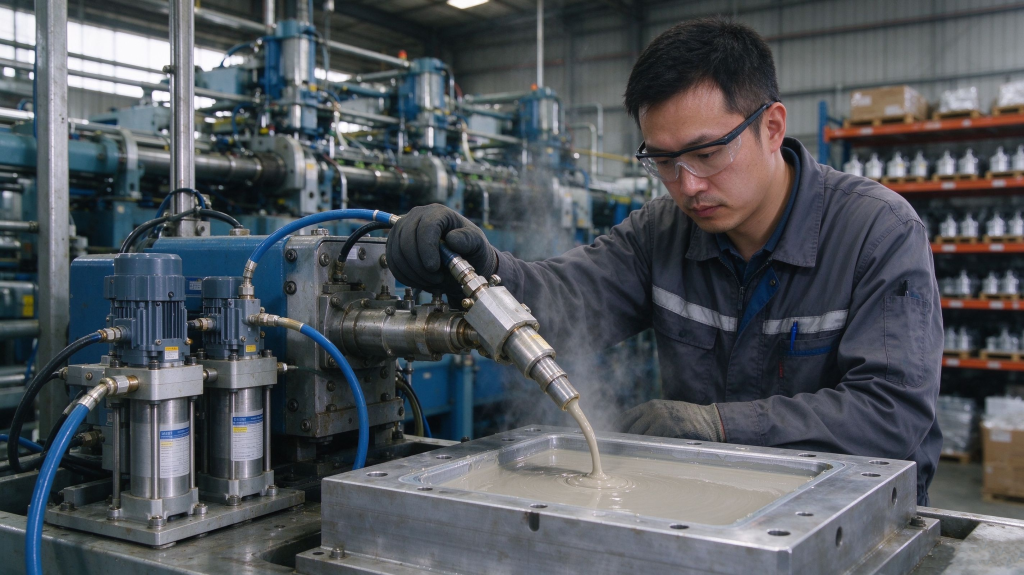
5. Tank Configuration: Volume, stirring structure and dual A-component tank design
A larger tank is not always better; the tank size should match your material preparation cycle. Focus on the stirring structure:
Paddle stirrer: suitable for A-component with fillers to prevent sedimentation and stratification.
Frame stirrer: suitable for high-viscosity raw materials that do not settle easily.
Dual A-component tank design is ideal for continuous production: one tank is used for stirring and preparing materials while the other supplies material for casting. No downtime is required for material mixing, which fits continuous coating lines such as carpet backing.
Also confirm that the tank is made of acid-resistant stainless steel, complete with heating and cooling jackets, sight glass, vent port, discharge port, return port, temperature probe and cooling water inlet and outlet, to reduce later modification work.
6. Mixing Head Parameters: Rotating speed and cleaning method
The mixing head is the heart of a casting machine. Uneven mixing will definitely lead to air bubbles, color difference and incomplete curing in finished products. For low-pressure casting machines with mechanical stirring mixing heads, check:
Rotating speed of the mixing head
Switching valve structure; three-position cylinder rotary valve switching is stable and reliable
Cleaning solution system and automatic cleaning function
Workshops that frequently switch formulas can save much manual cleaning time and reduce the risk of cured material blockage with the automatic cleaning function.
7. Electrical Components and Protection Functions, which decide long-term reliability
Do not only focus on the main unit. Electrical systems and protection functions greatly affect the failure rate of the equipment:
Independent digital displays for temperature, pressure and rotating speed for real-time parameter monitoring.
Alarm and shutdown protection for overpressure, material shortage and abnormal mixing ratio.
Recipe storage function, allowing direct recall of saved parameters for new products instead of repeated adjustment.
Industrial-grade export electrical components for easy spare parts procurement in the long run.
8. Supporting Process Service, more important than equipment parameters
The same casting machine delivers totally different results with or without professional process support. Some suppliers only sell mechanical equipment without formula debugging, sample trial casting or on-site commissioning service. When bubbles, delamination or unstable hardness occur, customers struggle to locate the problems by themselves.
Confirm before purchase: whether the supplier provides sample trial casting, on-site process commissioning, technical guidance for formula upgrading and long-term supply of wearing parts. For special processes such as MC nylon and polyurethane carpet backing, stable production can only be realized with integrated equipment and process service.
Summary
The correct selection logic for polyurethane casting machines is: confirm product type, formula, production capacity and filler content → calculate required discharge rate and mixing ratio range → match pumps, temperature control system, tanks and mixing head structure → then compare price and service.
Buying low-priced equipment with mismatched parameters will bring extra costs from defective products, production downtime and equipment modification, which often exceed the price gap of the machine.
If you are planning production lines for elastomer wheels, MC nylon parts, carpet backing or air filter sealing pads, send us your product samples and capacity requirements. Feilong Polyurethane can help you calculate parameters and provide solutions and trial casting support free of charge.
 FEILONG PU MACHINE